
How Much Time to Allow for Your Next Golf Round
By Reid Callahan · · 18 min read
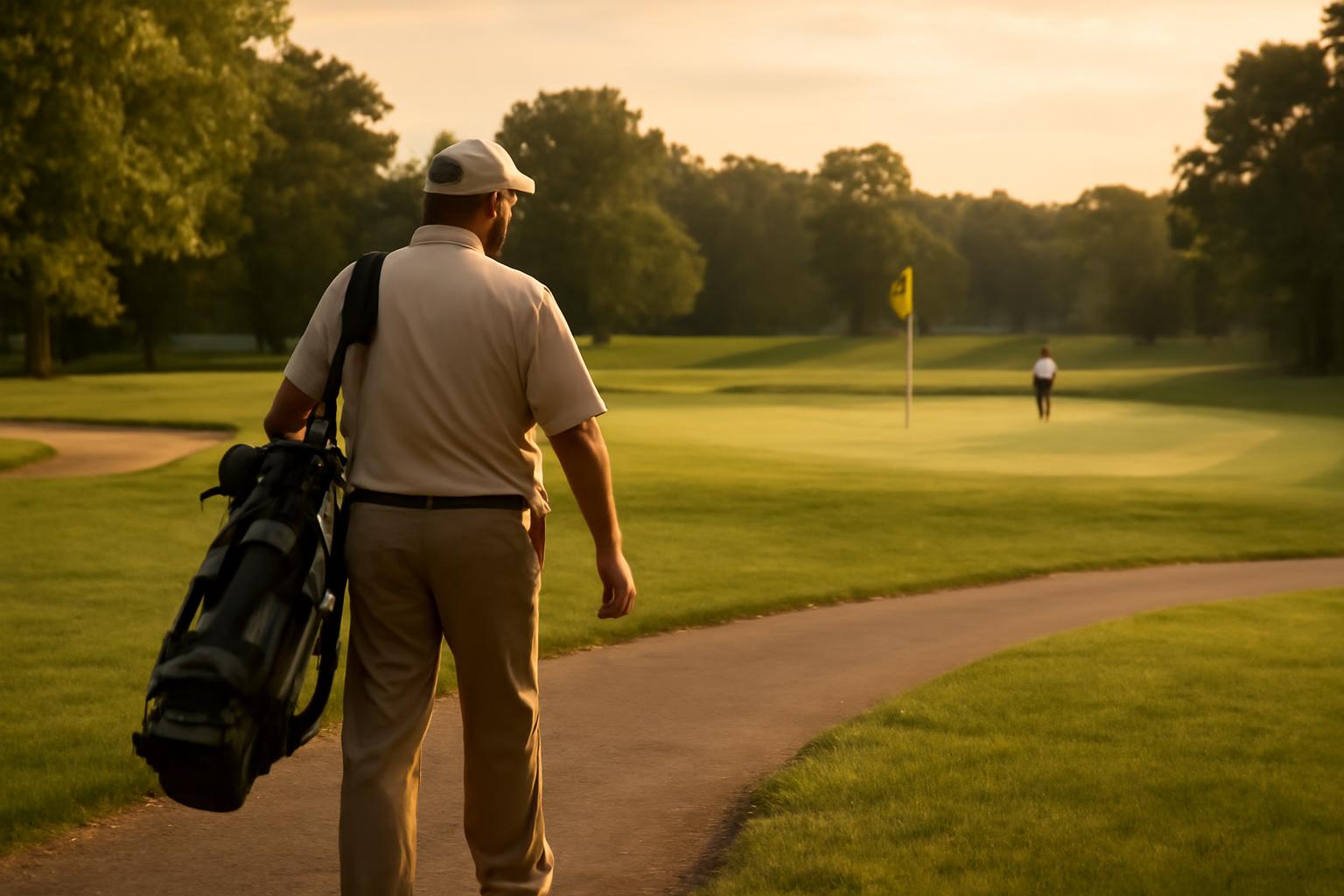
For practical scheduling, allow approximately 4–5 hours to play 18 holes. That is a broad planning range, not a guaranteed finish time. A normally paced foursome often completes the round in about 4–4.5 hours, but congestion, course difficulty, weather, and operating restrictions can extend the day (Genoa Golf Club’s 18-hole planning guide).
For 9 holes, allow approximately 1.5–2.5 hours, with about two hours as a useful starting point. The complete outing will take longer once you include parking, check-in, equipment collection, preparation, and departure.
An 18-hole course visit may therefore occupy approximately 5–6 hours, even when the round itself takes closer to four hours (Paradise Golf Course’s full-visit planning estimates). If you have a hard deadline, nine holes or a shorter course is safer than depending on an unusually fast full round.
The estimates in this guide synthesize planning ranges published by golf courses, booking services, retailers, and golf-travel businesses. Most do not disclose national datasets or standardized measurement methods, so every duration should be treated as scheduling guidance rather than a measured universal average.
The quick answer: typical times for 9 and 18 holes
An ordinary recreational round of 18 holes usually takes approximately 4–5 hours. For a normally paced foursome, 4–4.5 hours is a practical expectation. A busy or difficult course can push the finish toward five hours or longer (GolfTroop’s round-duration guide).
Nine holes generally require approximately 1.5–2.5 hours, with about two hours serving as a useful baseline. An open course and small group may finish sooner, while a crowded tee sheet or challenging layout may require the upper end of the range (Palm Desert Golf Country Club’s nine-hole timing guide).
| Hole count | Likely playing-time range | Sensible total-visit window |
|---|---|---|
| 9 holes | Approximately 1.5–2.5 hours | Approximately 2–3.25 hours |
| 18 holes | Approximately 4–5 hours | Approximately 5–6 hours |
The total-visit window allows time for parking, check-in, collecting clubs or a cart, preparing for the first tee, returning equipment, and leaving after play. It does not include travel to the course, a full meal, an extended halfway stop, or lengthy social time afterward.
These estimates describe recreational golf on a standard course. Professional tournaments, exceptional speed rounds, and speed-golf records are not useful comparisons because they involve different formats, incentives, course setups, and playing conditions.
Most importantly, “four hours” is not a promise. A well-organized foursome may still wait on every tee if the course is backed up. Conversely, a solo player or twosome with nobody ahead may finish well below the broad range.
Estimated round time by group size
More golfers usually mean more shots, club selections, putting routines, ball searches, and movement around each hole. A foursome will therefore usually take longer than a twosome when both groups have an open course.
The difference is not fixed. Adding one player does not add a predictable number of minutes.
Approximate 18-hole planning ranges are:
| Group size | Approximate 18-hole playing time | Critical assumption |
|---|---|---|
| 1 golfer | 2.5–3.5 hours | Open course with little or no waiting |
| 2 golfers | 3–4 hours | Open or lightly occupied course |
| 3 golfers | 3.5–4.5 hours | Ordinary conditions and efficient play |
| 4 golfers | 4–5 hours | Ordinary traffic; longer if congested |
These ranges deliberately allow more variation than a single point estimate. Published group-size estimates place solo play near 2.5–3 hours under favorable conditions, twosomes near 3–3.5 hours, threesomes near 3.5–4 hours, and foursomes near 4–4.5 hours; additional room is sensible when planning around ordinary course variation (Supreme Golf’s group-size estimates).
Approximate 9-hole planning ranges are:
| Group size | Approximate 9-hole playing time | Critical assumption |
|---|---|---|
| 1 golfer | 1–1.5 hours | Fast player on an open course |
| 2 golfers | 1.5–2 hours | Limited waiting ahead |
| 3 golfers | 2–2.5 hours | Ordinary recreational pace |
| 4 golfers | 2–3 hours | Varies substantially with traffic |
Published nine-hole estimates commonly place twosomes at about 1.5–2 hours, threesomes at 2–2.5 hours, and foursomes at up to approximately three hours depending on conditions (Lazrus Golf’s group-size duration guide).
The short solo and twosome estimates depend on an open course. A solo golfer who catches a line of foursomes cannot maintain a solo pace unless conditions and course procedures allow the golfer to pass.
Three common 18-hole scenarios show how the variables combine:
Small experienced group on an open course: A solo golfer or twosome may finish in approximately 2.5–4 hours. The players make decisions efficiently, keep balls in play, and encounter little waiting.
Normally paced foursome in ordinary traffic: Approximately 4–4.5 hours is a practical playing-time expectation. The group may wait occasionally but remains in position relative to the group ahead.
Foursome on a congested or difficult course: The round may approach five hours or run longer. Long transfers, hazards, ball searches, adverse weather, maintenance activity, and repeated waits can accumulate.
Group size is useful for selecting an initial range, but it cannot predict the finish by itself. Expected traffic should be the next variable you investigate.
Playing time versus the full golf outing
For this guide, “playing time” means the period from beginning the first hole until completing the last.
Your complete visit begins before the first shot. Before play, you may need to:
- Park and unload your equipment.
- Check in at the golf shop.
- Collect rental clubs or a cart.
- Change shoes and organize your bag.
- Use the practice green or range.
- Report to the starter.
- Wait for your assigned tee time.
After the round, you may need to return equipment, load your vehicle, change, and leave the property. Those activities make approximately 5–6 hours a sensible reservation for a typical 18-hole visit. For nine holes, adding approximately 30–45 minutes around the expected playing time provides a reasonable allowance for arrival, preparation, and departure.
Consider this sample schedule for a 9:00 a.m. 18-hole tee time:
| Time | Activity |
|---|---|
| 8:15–8:25 a.m. | Arrive, park, unload, and check in |
| 8:25–8:50 a.m. | Collect equipment and complete a brief warm-up |
| 8:50–9:00 a.m. | Report to the first tee and follow starter instructions |
| 9:00 a.m. | Expected tee-off |
| 1:00–2:00 p.m. | Likely playing finish range |
| After the actual finish | Allow approximately 15–30 minutes to return equipment, pack, and leave |
If the round finishes at 1:00 p.m., departure might be possible around 1:15–1:30 p.m. If it finishes at 2:00 p.m., a more realistic departure would be around 2:15–2:30 p.m. Follow the course’s requested arrival time rather than this generic example.
Travel remains separate. So do a sit-down meal, an extended halfway stop, and social time after the round. Heavy road traffic can make the door-to-door commitment considerably longer without changing the measured round time.
Do not schedule a firm appointment exactly four hours after an 18-hole tee time. That leaves no protection against a delayed start, congestion, a longer-than-planned round, or the journey from the 18th green to your next destination.
Why two rounds of the same length can finish hours apart
Round duration becomes easier to estimate when the variables are divided into conditions golfers can influence and conditions they usually cannot control.
Conditions golfers can influence
Group size: Smaller groups can move faster when the course is open because fewer people must complete each hole. On a busy course, the groups ahead may erase that advantage.
Readiness: A golfer who begins checking the distance and selecting a club only after everyone else has played creates avoidable dead time. Preparing while another player hits can reduce the delay, provided it does not distract anyone or interfere with safe play.
Pre-shot routines: A consistent routine can support good play, but repeated practice swings, lengthy deliberation, or unnecessarily restarting the routine can slow the entire group.
Ball tracking and searches: Watching each shot until it stops—or disappears near a specific reference point—makes the ball easier to locate. Delays multiply when several players lose sight of their shots and search without a clear starting area.
Player experience: Beginners may take more strokes, search for more balls, or need extra time because course procedures are unfamiliar. These factors may lengthen the round, but the evidence does not support adding a universal “beginner penalty” to every booking.
Unnecessary stops: Repeated trips to a cart, phone distractions, prolonged conversations when play is available, and poorly timed food or restroom stops can create small delays that accumulate.
Conditions golfers usually cannot control
Tee-sheet congestion: Closely spaced starts and a full course can create waiting throughout the day. Once a queue develops, even efficient groups may be unable to recover the lost time.
The groups ahead: A golfer cannot continue while the intended landing area remains occupied. This makes the pace ahead one of the strongest constraints on the finish time.
Course maintenance: Mowing, repair work, temporary routing, aeration-related procedures, or other operations may affect movement and playing conditions.
Weather: Rain, wind, heat, or cold can affect club selection, footing, visibility, equipment handling, and the frequency of delays. There is no reliable universal number of minutes to add for a specific type of weather.
Cart restrictions: A cart-path-only instruction can require golfers to walk across a fairway, carry several possible clubs, and return to the cart after each shot. This can remove much of the cart’s travel advantage.
Local pace policies: Starter procedures, expected position, player-assistance practices, group-size rules, and protocols for allowing faster groups through vary by course.
The physical layout also matters. A long course generally requires more movement and more full shots than a short one. Long transfers between greens and the next tees add time without appearing on the scorecard. Hills may slow walkers, while narrow landing areas, thick rough, water, bunkers, out-of-bounds areas, and complex greens can increase searches and decision time.
That is why two 18-hole rounds can finish hours apart even when the players have similar abilities. One group may play a compact course with open fairways and nobody ahead. Another may encounter long transfers, a crowded tee sheet, cart restrictions, difficult rough, maintenance, and adverse weather.
Before relying on a general estimate, check the facility’s posted pace target. Ask the pro shop or starter about:
- Current tee-sheet traffic.
- Recent finish times.
- Maintenance or temporary holes.
- Cart restrictions.
- Expected halfway procedures.
- The course’s policy if your group falls behind.
A course-specific pace target combined with current conditions is more useful than treating a broad planning range as a promise.
Does walking or using a cart make the round faster?
A golf cart can reduce travel time on some courses, but it does not guarantee an earlier finish.
Riding is most likely to help when the course has long distances between holes, substantial hills, or widely separated landing areas. The benefit is greatest when the course is open, carts have useful access, and the riders coordinate their movement efficiently.
The advantage may disappear when:
- The course is congested.
- Carts must remain on paths.
- Two riders repeatedly drive to one ball, wait, and then drive to the other.
- The players’ balls are on opposite sides of the hole.
- The layout is compact and easy to walk.
- Cart parking areas cause repeated backtracking.
On compact courses, walking can be competitive with riding because each golfer can move directly toward their own ball. Walkers also keep their clubs with them, avoiding repeated trips between the ball and a parked cart.
Efficient shared-cart habits include:
- Take the clubs you are likely to need when walking to your ball.
- When safe and permitted, leave one player near their ball before the other rider continues to a separate ball.
- If the balls are close, park where both players can reach them without unnecessary repositioning.
- Bring a putter and likely short-game clubs when approaching the green.
- Park on the side of the green that leads naturally toward the next tee.
- Record scores after moving away rather than while blocking the completed green.
Poorly coordinated shared-cart movement is a recognized source of delay, while dropping off one rider or parking between two nearby balls allows both golfers to prepare at the same time (Alamo City Golf Trail’s cart-use guidance).
Do not assign a fixed number of minutes that a cart will save or walking will add. Transportation is only one component of pace and is often less important than traffic. A cart may reach the next shot quickly, but it will spend the saved time parked if the landing area is not clear.
Choose between walking and riding based on the layout, physical comfort, weather, access rules, and local restrictions—not on an assumption that one method is always faster.
Course type and format change the estimate
Not every nine-hole or 18-hole experience requires the same amount of time. Course distance, design, and movement between shots can change the commitment substantially.
A full-length course generally takes longer than an executive or par-3 layout. Players cover more ground, hit more long shots, and may encounter wider separation between holes. On a standard full-length layout, approximately two hours for nine holes remains a reasonable benchmark, subject to traffic and group size.
A nine-hole par-3 course may take a little over an hour under suitable conditions. That is not a universal duration: crowded conditions, difficult par 3s, inexperienced groups, and local operating procedures can all make it longer. GolfNow distinguishes the roughly two-hour commitment of nine championship-length holes from the shorter outing possible on a par-3 course (GolfNow’s guide to nine-hole formats).
An executive course usually combines shorter holes, often with more par 3s and fewer long par 4s or par 5s than a standard full-length course. It can be a practical middle ground for someone who wants more than a brief practice session but cannot commit to a conventional 18-hole visit. Because designs vary, check the course’s own pace expectation.
Some facilities also offer 12-hole rounds. Where available, that format can fit between nine and 18 holes, providing more golf than a short outing without requiring a full-round commitment. Do not assume that every course or area offers it.
For time-constrained golfers, the key planning principle is simple: select a format that fits the real schedule instead of depending on an exceptionally fast 18-hole round. Options may include:
- Nine holes on a full-length course.
- A nine-hole par-3 course.
- An executive layout.
- A 12-hole option where offered.
- A practice session combined with a few short holes.
Professional tournaments and record-setting rounds are not appropriate planning comparisons. Estimate from the course you will actually play, your expected group size, and current traffic.
When an 18-hole round under four hours is realistic
Finishing 18 holes in less than four hours is plausible, but it should not be assumed for every booking.
The most favorable combination includes:
- A solo player or small experienced group.
- An open course with little waiting.
- An early or otherwise uncongested tee time.
- A compact or straightforward layout.
- Balls kept in play.
- Efficient movement between shots and holes.
- Minimal unnecessary stopping.
- No restrictive cart or maintenance conditions.
An early tee time may improve the chance of open space ahead, particularly if the group is among the first to start. It is not a guarantee. Maintenance activity, delayed starts, events, tightly spaced bookings, or a slow opening group can still affect the round. When planning, check the course’s tee-time booking windows and ask which periods are usually less congested.
A foursome may also finish near or below four hours when the course is open and the players maintain position. Even so, 4–4.5 hours remains safer planning guidance for a typical foursome because it allows for ordinary waits and variation (GolfTroop’s guidance for foursomes and open-course play).
Calculate a provisional finish from the individual course’s posted pace target. If the facility lists a four-hour-and-20-minute target and the tee time is 8:30 a.m., the provisional playing finish is 12:50 p.m. Then add time for leaving the property and reaching the next destination.
Treat the result as an estimate, not a deadline guarantee. Ask whether current groups are running on schedule and whether maintenance or access restrictions are in effect.
Hard-deadline decision
If finishing by a specific time is essential, choose nine holes, an executive layout, or a par-3 course. Do not make an immovable work, travel, or childcare commitment depend on completing 18 holes unusually quickly.
Sub-four-hour play should result from favorable conditions and efficient transitions—not rushed swings, skipped safety checks, or pressure on the group ahead.
How to keep pace without rushing
Good pace does not mean swinging before you are ready. It means preparing in advance, moving efficiently, and maintaining a safe position on the course.
Use safe ready golf in casual play
Prepare while another golfer is playing. Check your distance, consider the likely club, put on your glove, and plan the shot before your turn. When it is safe, appropriate, and consistent with the format, the golfer who is ready may play rather than waiting unnecessarily for a strict sequence.
Competitions and local procedures may govern order of play differently. Follow committee instructions and directions from course staff.
Select suitable tees
Choose tees that match each golfer’s ability and typical distance. A course that is too long can produce more forced carries, difficult recovery shots, and searches. Golfers in the same group do not necessarily need to play identical tees if the facility permits different choices.
Prepare before reaching the ball
Use the walk or cart ride to consider the likely distance, wind, lie, and club choice. Confirm the details at the ball without beginning the entire decision process from zero.
Limit unnecessary practice swings. The aim is not to eliminate a useful routine but to make it consistent and efficient.
Watch every shot
Follow the ball until it stops or disappears near a clear reference point. Watch your partners’ shots as well. A tree, bunker edge, yardage marker, or other fixed feature provides a better search reference than a vague direction.
Keep searches efficient and follow the procedures applicable to the format and course. If a ball is unlikely to be found promptly, use the available option rather than continuing an unproductive search indefinitely.
Move equipment intelligently
When leaving a cart, take several clubs if the exact shot or lie is uncertain. A player approaching a green might carry a wedge and putter instead of returning to the cart after a chip.
Place bags, push carts, and riding carts on the side of the green nearest the route to the next tee. Avoid leaving equipment where the entire group must walk backward after putting out.
Clear completed greens
Once the hole is finished, move away so the group behind can proceed when appropriate. Record scores at the next tee when practical rather than standing beside the completed green.
Maintain position
The group ahead is the most visible reference. If it is consistently out of range and an empty hole has opened, your group may need to reduce avoidable delays and close the gap safely.
When behind pace:
- Identify where the group is losing time.
- Prepare earlier and move promptly between shots.
- Shorten unnecessary routines without rushing the swing.
- Follow ranger or player-assistance instructions.
- Allow a faster group through when course policy and conditions permit.
- Wait until the intended playing area is safely clear before making a shot.
Readiness, suitable tees, efficient cart use, ball tracking, and prompt movement are recurring recommendations in course pace guidance (Plum Creek Golf Course’s pace-of-play guide).
The best pace habits are almost invisible. Golfers make decisions while others play, carry the right clubs, watch shots, move toward the next position, and remain considerate of everyone around them.
Frequently asked questions
How long does 18 holes take for a foursome?
Allow approximately 4–5 hours of playing time. A normally paced foursome may finish in about 4–4.5 hours, while a crowded, difficult, or restricted course can push the round toward five hours or longer (Plum Creek Golf Course’s foursome estimates).
For the complete visit, reserving approximately 5–6 hours is safer once arrival, check-in, preparation, and departure are included. Use the course’s posted pace and current traffic report to refine the estimate.
How long does it take to play 9 holes of golf?
Nine holes generally take approximately 1.5–2.5 hours, with about two hours as a useful baseline. A fast solo golfer on an open course may finish near the lower end, while a foursome or congested course may require two to three hours (Under Armour’s nine-hole pace guide).
Add approximately 30–45 minutes for parking, check-in, preparation, and departure when planning the complete visit.
Does a golf cart always make a round faster?
No. A cart can reduce travel time on a long, hilly, or spread-out course, particularly when the course is open and cart access is unrestricted. It cannot overcome congestion ahead.
Cart-path-only rules, poorly coordinated shared-cart use, and repeated backtracking may erase the advantage. Walking can be competitive on compact layouts because each player can move directly toward their own ball (Alamo City Golf Trail’s walking and cart discussion).
How long should a beginner allow for a round of golf?
A beginner should start with the same broad planning ranges—approximately 4–5 hours for 18 holes or 1.5–2.5 hours for nine—but allow flexibility rather than applying a fixed time penalty.
Beginners may take more shots, conduct more searches, or need longer for unfamiliar procedures. No reliable universal beginner surcharge applies. Suitable tees, a less congested booking, careful ball tracking, and familiarity with local pace expectations can make the outing smoother.
For a first course visit, nine holes is often the easier scheduling choice because it provides time to learn without requiring most of the day.
What is the best way to estimate my actual finish time?
Start with the individual course’s posted pace target and add it to your tee time. Course targets can differ; one commonly cited example is four hours and 20 minutes, but current traffic may still determine the actual finish (starter and ranger perspective on course pace targets).
Then adjust your planning for:
- Group size and experience.
- Expected traffic.
- Course length and difficulty.
- Walking or riding conditions.
- Cart restrictions.
- Weather and maintenance.
- Planned halfway stops.
- Time needed to leave the facility.
Ask the pro shop whether current groups are finishing on schedule. Finally, add a departure buffer rather than treating the calculated finish as a guarantee.
The practical scheduling rule is to allow approximately 4–5 hours to play 18 holes, around two hours for nine, and additional time for check-in, preparation, and departure. The course ahead often controls the finish, so check current conditions and choose a round length that fits your actual deadline. Maintain pace through readiness and efficient movement—not unsafe rushing.