
The average round of 18 holes of golf takes 4 hours and 17 minutes.
USGA pace-of-play data from over 40,000 GPS-tracked rounds breaks 18-hole round time down by time of day, course type, weekday vs. weekend, and group size.
By Reid Callahan · · 1 min read
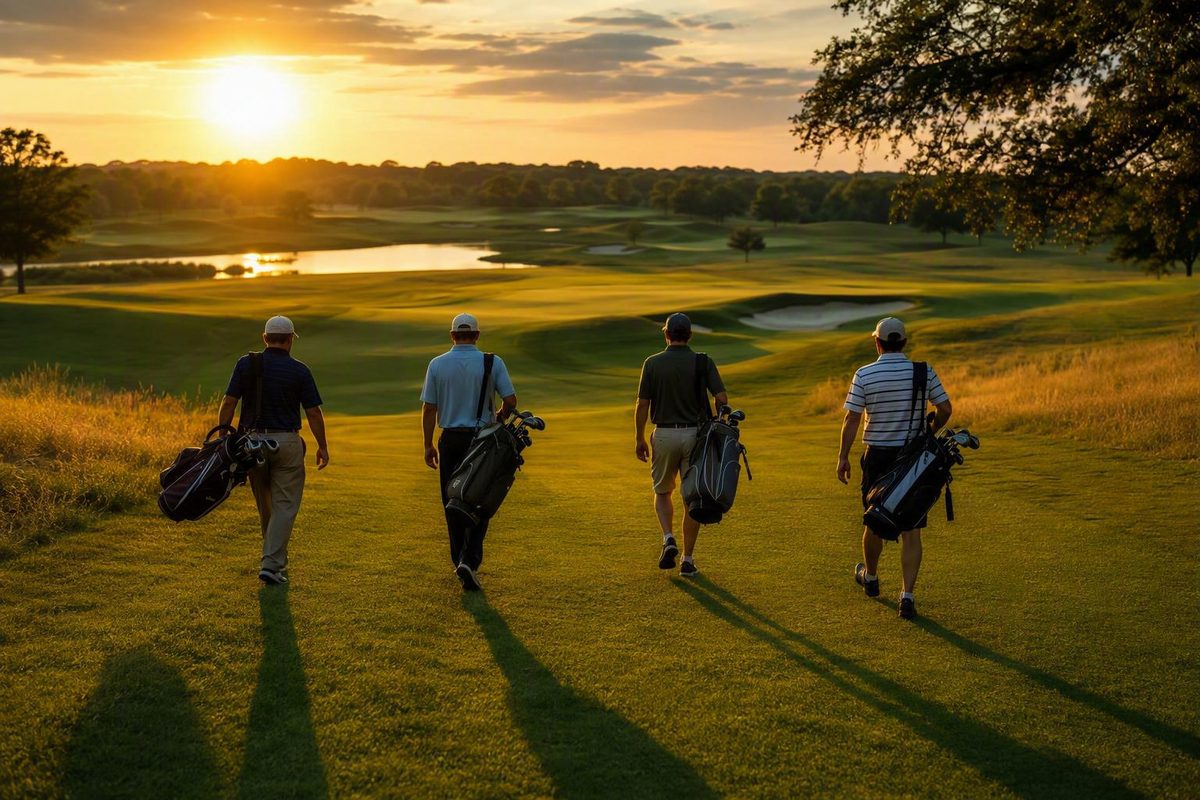
The average round of 18 holes of golf takes 4 hours and 17 minutes, according to USGA pace-of-play data covering more than 40,000 GPS-tracked rounds. Course type, tee time, and day of week move that number by 30 to 70 minutes in either direction — private clubs, mornings, and weekdays finish fastest, while public courses, afternoons, and weekends run longest.
Sort and filter. Click any column to re-sort the table, or use the dropdown to isolate one breakdown at a time.
| Dimension | Subgroup | Value | Unit | Context | Source |
|---|---|---|---|---|---|
| Overall | National average — 40,460 rounds, 175 US courses | 4:17 | h:mm round time | GPS-tracked rounds, Three45 Golf Association / Riccio study | USGA — three45ga.pdf |
| Time of day | Morning (AM) rounds | 4:02 | h:mm round time | Three45 study | USGA — three45ga.pdf |
| Time of day | Afternoon (PM) rounds | 4:21 | h:mm round time | Three45 study | USGA — three45ga.pdf |
| Time of day | First round of the day (unimpeded, all clubs) | 3:46 | h:mm round time | Three45 study | USGA — three45ga.pdf |
| Weekday vs weekend | Weekday (Mon–Thu) | 4:13 | h:mm round time | Three45 study | USGA — three45ga.pdf |
| Weekday vs weekend | Weekend (Fri–Sun) | 4:23 | h:mm round time | Three45 study | USGA — three45ga.pdf |
| Course type | Private clubs (PGA Tour TPC Study, cited in Three45 presentation) | 4:10 | h:mm round time | Cross-study citation inside the Three45 deck | USGA — three45ga.pdf |
| Course type | Public courses (PGA Tour TPC Study, cited in Three45 presentation) | 4:30 | h:mm round time | Cross-study citation inside the Three45 deck | USGA — three45ga.pdf |
| Course type | Private, fastest examples — Coral Ridge CC (FL), Stoney Brook GC (FL) | ~3:20 | h:mm round time | Named-course extremes from the Three45 study, as reported by golf writer Josh Bills; not independently confirmed in the primary PDF's extracted text | GolfClubAtlas forum (secondary summary of Three45 study) |
| Course type | Public, slowest examples — Arcadia Bluffs (MI), The Quarry (TX) | ~5:00 | h:mm round time | Named-course extremes from the Three45 study, as reported by golf writer Josh Bills; not independently confirmed in the primary PDF's extracted text | GolfClubAtlas forum (secondary summary of Three45 study) |
| Round-time distribution | Rounds completed under 4:00 | 28.5% | % of rounds | Three45 study | USGA — three45ga.pdf |
| Round-time distribution | Rounds exceeding 4:30 | 36.5% | % of rounds | Three45 study | USGA — three45ga.pdf |
| Round-time distribution | Rounds exceeding 5:00 | 10.4% | % of rounds | Three45 study | USGA — three45ga.pdf |
| Round-time distribution | Courses averaging under 4:00 (course-level, not round-level) | 18.8% | % of courses | Three45 study | USGA — three45ga.pdf |
| Tee-time interval (simulation) | 10-minute intervals, 2.0 mph walking pace | ~4:00 | h:mm, simulated | Three45/USGA tee-interval simulation model | USGA — three45ga.pdf |
| Tee-time interval (simulation) | 8-minute intervals, 2.0 mph walking pace | ~4:45 | h:mm, simulated | Three45/USGA tee-interval simulation model | USGA — three45ga.pdf |
| Tee-time interval (simulation) | 7-minute intervals, 2.0 mph walking pace | ~5:15 | h:mm, simulated | Three45/USGA tee-interval simulation model | USGA — three45ga.pdf |
| Tee-time interval (spreadsheet model) | Baseline — no tee-time waiting | 4:03 | h:mm, model output | Andrew Tiger's spreadsheet simulation, USGA Pace of Play Symposium | USGA — pace-of-play-modeling.pdf |
| Tee-time interval (spreadsheet model) | 8-minute tee intervals | ~4:23 | h:mm, model output | Andrew Tiger's spreadsheet simulation | USGA — pace-of-play-modeling.pdf |
| Tee-time interval (spreadsheet model) | 15-minute tee intervals | ~5:13 | h:mm, model output | Andrew Tiger's spreadsheet simulation | USGA — pace-of-play-modeling.pdf |
| Tee-time interval (spreadsheet model) | Shotgun start, 36-group field | ~4:48 | h:mm, model output | Modeled 4:31 no-wait baseline for shotgun format, average completion reported as 4.8 hours with 36 groups | USGA — pace-of-play-modeling.pdf |
| Group size | Four-ball, R&A standard time-par model (10 min/par-3, 13 min/par-4, 16 min/par-5) | ~4:00 | h:mm, recommended standard | R&A's own stated approximate total for this par-time model | R&A Pace of Play Manual |
| Group size | Two-ball — recommended starting interval between groups | ≥8 | minutes (interval, not round duration) | R&A does not quantify a full-round total for two-balls | R&A Pace of Play Manual |
| Group size | Three-ball — recommended starting interval between groups | ≥10 | minutes (interval, not round duration) | R&A does not quantify a full-round total for three-balls | R&A Pace of Play Manual |
| Group size | Four-ball — recommended starting interval between groups | 11–12 | minutes (interval, not round duration) | R&A recommended range | R&A Pace of Play Manual |
| Group size (spreadsheet model, per-hole) | Twosome, walking | 11.3 | minutes per hole, model output | Andrew Tiger's spreadsheet simulation; not a full 18-hole total | USGA — pace-of-play-modeling.pdf |
| Group size (spreadsheet model, per-hole) | Threesome, walking | 12.7 | minutes per hole, model output | Andrew Tiger's spreadsheet simulation; not a full 18-hole total | USGA — pace-of-play-modeling.pdf |
| Group size (spreadsheet model, per-hole) | Foursome, two carts (shared/direct) | 9.7 | minutes per hole, model output | Andrew Tiger's spreadsheet simulation; not a full 18-hole total | USGA — pace-of-play-modeling.pdf |
| Group size (spreadsheet model, per-hole) | Foursome, carts (cart-path-only) | 11.4 | minutes per hole, model output | Andrew Tiger's spreadsheet simulation; not a full 18-hole total | USGA — pace-of-play-modeling.pdf |
| Recommended / target | Three45 Golf Association's own naming target | 4:45 | h:mm, organizational target | Association named for Riccio's stated ideal round-time target | USGA — Lou Riccio's Golf Laboratory article |
Dimension groups multiple breakdowns (course type, time of day, weekday/weekend, tee-time interval, group size, round-time distribution, recommended targets) in one table; subgroup names the specific bucket within each dimension. Values prefixed with ~ are secondary-sourced or model-simulated rather than directly reported field averages — see Gaps below.
Sources
- Three/45 Golf Association Research on Pace of Play Data Analysis Study — USGA (Riccio / Three45 Golf Association) (primary)
40,460 GPS-tracked rounds across 175 US courses. usga.org blocks direct WebFetch (403); fetched via the https://r.jina.ai/ reader proxy. - Pace of Play Symposium — spreadsheet simulation model (Andrew Tiger) — USGA (primary)
Tee-interval and group-size simulation outputs. Fetched via r.jina.ai proxy after direct WebFetch returned unreadable binary. - The R&A Pace of Play Manual — The R&A (primary)
Direct WebFetch returned HTTP 422 on the binary PDF; fetched via r.jina.ai proxy instead. Cites a 2014/15 international survey of 56,000 golfers. - Pace of Play Recent Study and Data (forum thread quoting Josh Bills) — GolfClubAtlas.com forum (secondary)
Direct WebFetch returned 403; fetched via r.jina.ai. Only source found naming specific fastest/slowest courses with exact times from the Three45 study. - How long does it take to play golf? 10 findings from the data — FairwayIQ (secondary)
Corroborates the Three45 study's overall/AM-PM/weekday-weekend figures; reports a conflicting version of the fastest-five/slowest-five course figures (3:36/4:50) not used in this table — see Gaps. - Lou Riccio's Golf Laboratory — USGA (secondary)
Direct WebFetch returned 403; fetched via r.jina.ai. Source of the 'Three45' target-time naming and the 45-second shot-time rule; no additional duration breakdowns. - Analyzing the Pace of Play in Golf: The Golf Course as a Factory (Riccio, 2012) — International Journal of Golf Science (paywalled)
URL verified live but only a PDF-viewer wrapper is fetchable, not article text. No figures from this source are used. - Improving Golf Pace of Play Using Time Study Analysis (Tiger & Ellerbrook, 2016) — International Journal of Golf Science (paywalled)
URL verified live (PDF downloads) but neither WebFetch nor the r.jina.ai proxy could extract readable text from the binary. No figures from this source are used.
Method
Ran 2 WebSearch queries (Riccio/Three45 study; USGA pace-of-play PDFs) before the session's WebSearch budget was exhausted, then fell back to https://html.duckduckgo.com/html/?q=... via WebFetch for 6 more queries (Andrew Tiger spreadsheet model, R&A pace-of-play research, municipal course round times, resort course round times, Riccio's academic papers, group-size specifics) — 8 distinct searches total. usga.org and randa.org PDFs return 403/422 to direct WebFetch, so every USGA- and R&A-hosted PDF was fetched through the https://r.jina.ai/ reader proxy; where a first summarized pass looked ambiguous (e.g. the private/public course-type split), a second pass asked the proxy for verbatim quotes only. Every URL listed in Sources was independently confirmed live with WebFetch, including the two paywalled academic-journal links, which resolve but yield no extractable text.
Gaps
Resort and municipal course types: we couldn't find one. Both primary studies used here (the Three45/USGA GPS study and the PGA Tour TPC study cited inside it) split course type as private vs. public only; resort courses are typically folded into 'public' in this kind of data and no municipal-specific timing turned up in any of the 8 sources searched, including a dedicated National Golf Foundation article on municipal golf (checked directly, no duration data). The named fastest/slowest course figures (~3:20 private, ~5:00 public) come from a secondary forum post summarizing the Three45 study, not from the primary PDF's own extracted text, which only confirmed the qualitative '5 fastest = private / 5 slowest = public' framing without exact minutes; a second secondary source (FairwayIQ) reports different numbers for the same claim (3:36/4:50) — both are approximate and the two disagree, so treat the ~3:20/~5:00 figures as illustrative rather than precise. The four Andrew Tiger group-size rows report minutes PER HOLE from his spreadsheet model, not full 18-hole totals; the source doesn't cleanly break out a full-round total by group size, and multiplying by 18 would overstate precision since the model excludes tee-wait time, so no such conversion was computed — do not compare these directly to the hour-based rows elsewhere in the table. The R&A manual explicitly states it does not quantify total round time by group size beyond the four-ball standard-time-par model, so the two-ball/three-ball 'group size' rows report the recommended starting INTERVAL between groups, not a round duration. Round-time distribution percentages are reported exactly as stated in the source and were not forced to reconcile to 100%. Riccio's own 2012 peer-reviewed paper and the 2016 Tiger/Ellerbrook time-study paper were both located and their URLs verified live, but sit behind a PDF-viewer wrapper neither WebFetch nor the r.jina.ai proxy could extract text from, so no figures from those two academic papers appear in this table.