
Get the Right Golf Cart Tire Pressure for Safer, Smoother Public Course Play
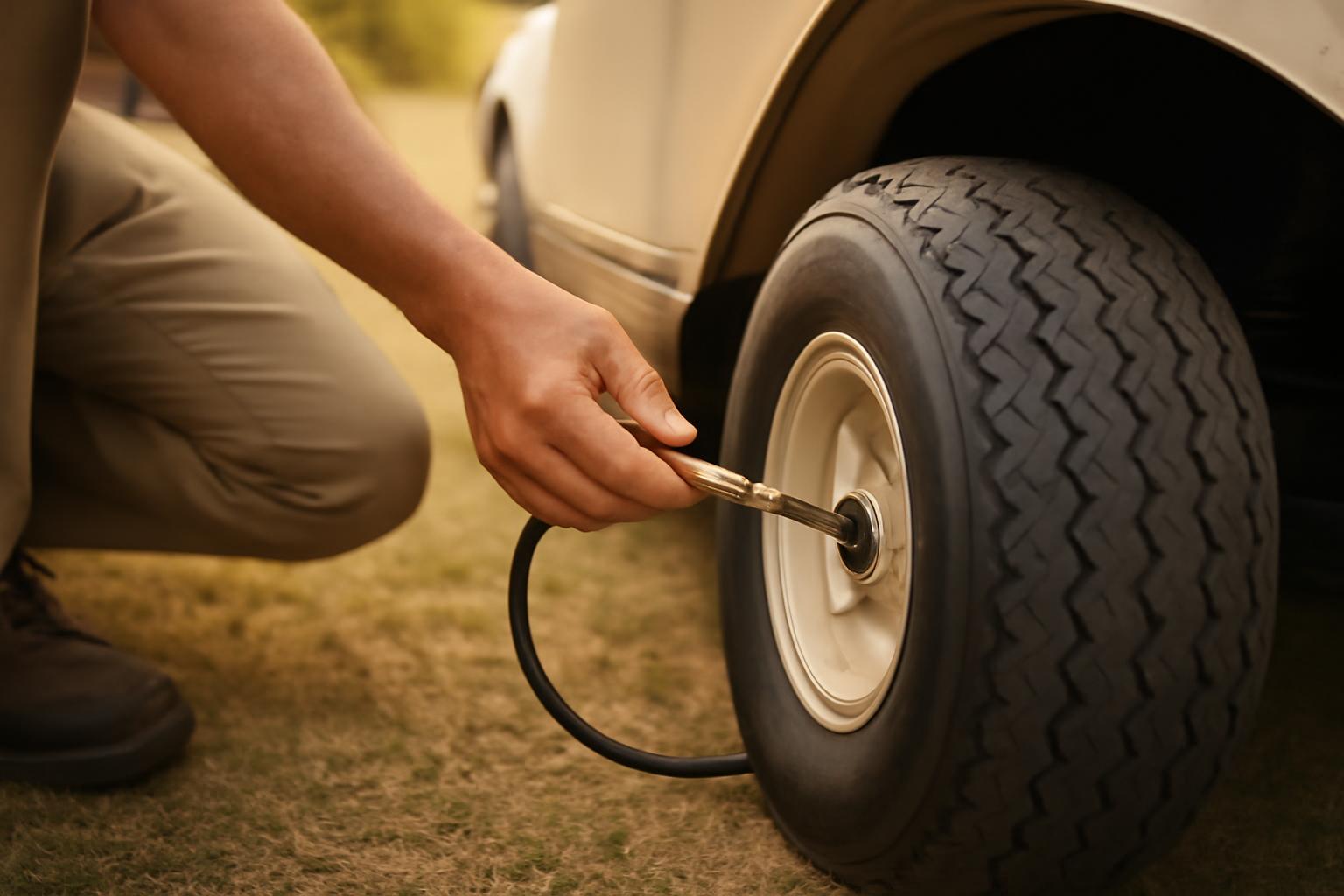
If you want the short answer on golf cart tire pressure, most published guides put many golf cart tires somewhere in the 15-25 PSI range, with around 20 PSI often cited as a practical middle number. But that is only a starting point, not a universal setting.
The exact pressure for your cart depends on the specific tire installed. Check the tire sidewall for inflation information, the owner’s manual if the cart still has its factory tire setup, and the manufacturer if the sidewall is worn or unclear. That distinction matters because some sidewalls may show a maximum PSI, not necessarily the ideal everyday operating pressure. If the wording is ambiguous, do not guess from the number alone.
That is the safest way to use any golf cart PSI guide, especially because most published ranges available to consumers come from aftermarket tire sellers, service shops, and parts retailers, not from one single OEM standard.
Proper inflation helps with the things golfers actually notice: stable handling, a smoother ride on cart paths, more even tire wear, and less avoidable stress on the cart and tires. For anyone using a cart regularly, checking pressure is simple maintenance that helps the cart feel predictable instead of vague, draggy, or harsh.
Why Golf Cart Tire Pressure Matters for Your Round
Tire pressure affects more than comfort. Across multiple golf cart tire guides, correct inflation is tied to safety, tire life, ride quality, handling, and efficiency, whether your cart is battery-powered or gas-powered. When the tires are set correctly, the cart is more likely to steer consistently, absorb bumps better, and wear its tires more evenly.
That matters on public courses because carts regularly deal with:
- long paved cart-path stretches
- repeated starts and stops
- curbs, seams, and uneven path edges
- damp mornings or wet-weather restrictions
- mixed-use conditions where traction and ride quality both matter
Tee Directory’s public-course guidance also notes that course conditions and timing often include cart-path-only windows. In those situations, you may spend even more time on hard surfaces and make more frequent turns and stops. Correct inflation does not guarantee a better round, but it does support more predictable cart behavior in exactly those higher-use conditions.
The practical effects are straightforward:
- Too little pressure can make a cart feel sluggish, soft, or less responsive.
- Too much pressure can make the ride feel jarring and reduce how planted the cart feels over cracks and rough pavement.
- Proper pressure helps the cart feel steadier and more comfortable.
That is the real public-course angle. The evidence supports better handling, comfort, wear, and efficiency. It does not strongly support a measurable pace-of-play effect, so it is better to think of tire pressure as a way to avoid preventable maintenance headaches and rough cart behavior, not as a proven round-time shortcut.
Evidence note: The benefit claims in this section come from golf cart tire maintenance guides published by service shops and tire sellers, plus Tee Directory’s separate discussion of public-course cart policies and cart-path-only conditions.
Standard Recommended PSI Range for Golf Cart Tires
Across several published golf cart tire guides, the broad recurring answer is that many golf cart tires fall in the 15-25 PSI range, with around 20 PSI often treated as a reasonable average. Some guides recommend a 20-22 PSI middle zone for many common course-use setups.
Here is the safest way to interpret those numbers:
| Published figure | How to use it |
|---|---|
| 15-25 PSI | Common general range repeated across many golf cart tire guides |
| Around 20 PSI | Frequently cited average or middle-of-the-road reference point |
| 20-22 PSI | A common “middle range” suggestion in some seller and service guides |
| Up to 35-40 PSI on some tires | Usually a tire-specific high limit or design characteristic, not a universal everyday target |
That last row is where confusion starts. Some tires do show numbers much higher than 25 PSI. But a high number on a sidewall does not automatically mean that is the operating pressure you should use for routine driving. In consumer-facing material, sidewall numbers are sometimes discussed loosely, and some sidewalls may emphasize maximum pressure rather than a clearly worded recommended cold inflation target.
So the most reliable sequence is:
- Treat 15-25 PSI as a broad expectation for many golf cart tires.
- Use around 20 PSI only as a rough benchmark.
- Read the installed tire carefully.
- If the sidewall wording is unclear, use the owner’s manual or manufacturer guidance instead of inferring from a single number.
A few additional nuances from the evidence set are worth knowing:
- Some guides say standard tires often run in the 18-22 PSI neighborhood.
- Some guides say low-profile or less typical tires may run higher.
- Off-road or special-use tires vary more widely than everyday course tires.
- Temperature changes can make a low-PSI tire feel noticeably different from season to season.
The safest summary is still the simplest one: 15-25 PSI is a common general range, but your exact tire’s verified inflation guidance matters more than a generic chart.
Source context: The 15-25 PSI range and the “around 20 PSI” average are repeated across guides from J’s Golf Carts, Golf Cart Garage, Extreme Kartz, Antego Tire & Wheel, Pete’s Golf Carts, and other aftermarket seller/service sources. That repetition is useful, but it is still not the same as an OEM universal standard.
How to Find the Exact PSI for Your Tires
The fastest place to look is the tire sidewall, because that is the tire actually mounted on the cart. You will usually find molded information there alongside the tire size, such as 18x8.50-8 or a similar marking.
But because sidewall wording can be misunderstood, do not stop at “find a number.” Make sure you are reading inflation guidance, not just a maximum PSI.
Use this order:
-
Inspect the installed tire’s sidewall. Look for wording that clearly identifies inflation information.
-
Use the owner’s manual if the sidewall is unclear. This is especially helpful if the cart still has its factory tire setup.
-
Contact the manufacturer if you still cannot verify it. If the sidewall is worn, incomplete, or seems to show only a maximum pressure, manufacturer confirmation is safer than guessing.
A few practical checks make a big difference.
Read the tire you actually have
Many carts no longer wear their original tires. A cart may have been switched to:
- street tires
- turf tires
- all-terrain tires
- low-profile tires
- another aftermarket size or brand
If that happened, the generic pressure advice tied to the original cart model may no longer be the best answer. The installed tire matters.
Check pressure when the tires are cold
Multiple guides define a proper cold reading as a tire checked after sitting for several hours, commonly about three hours or more. If you check right after driving, the reading may be higher than your true baseline.
Do not assume one cart matches another
Two similar-looking carts can use different tires, sizes, constructions, and load ratings. Even if a friend’s Club Car or E-Z-GO runs happily at one setting, your cart may not.
If the information is unclear, stop short of guessing
This is the key safety edit most articles need. It is common to read advice like “the sidewall tells you the exact PSI.” Sometimes it does. Sometimes it only gives part of the picture. If you cannot tell whether the number is a recommended cold inflation figure or a maximum pressure, use the manual or confirm with the manufacturer.
That extra step is better than building your tire maintenance around a misunderstood sidewall marking.
PSI Recommendations by Common Tire Types
This is the section where caution matters most. The published tire-type numbers below are aftermarket consensus ranges, not universal factory standards. They can help you sanity-check a setup, but they should not outrank the specific tire on your cart.
Commonly published examples include:
| Tire category | Commonly cited aftermarket range | How much confidence to place in it |
|---|---|---|
| Factory Sawtooth (18x8.50-8) | 18-22 PSI | Useful as a common fleet-style reference, but still not universal |
| Street/Turf | 20-24 PSI | Frequently repeated for path and pavement use |
| All-Terrain | 18-20 PSI | Common starting range, but designs vary a lot |
| Full Turf | 20 PSI | Often listed as a simple midpoint, not a rule |
Those figures appear repeatedly in aftermarket tire guides, especially from golf cart wheel and tire sellers. They are helpful as orientation. They are not the last word.
Why the caution? Because the evidence set also shows conflicting subtype advice:
- one guide places turf tires in the broad 15-25 PSI range
- another lists street/pavement tires at 20-25 PSI
- another gives much lower numbers for certain turf or off-road categories
- still another notes that some off-road tires can run far higher depending on design
That tells you something important: category labels are not precise enough by themselves.
A few practical takeaways:
- If your pressure is wildly outside what is commonly published for that tire type, recheck it.
- If your sidewall or manual confirms a number near those published ranges, you are probably looking at a normal setup.
- If your installed tire conflicts with a generic category chart, follow the installed tire and manufacturer guidance.
This also explains why exact-looking charts can be misleading. A table makes the numbers look official. In reality, these are best used as rough comparison points pulled from aftermarket guidance.
For public-course use, that is usually enough. Most golfers just need to know whether their cart is in a normal range or obviously off. Tire-type tables can help with that, but they cannot replace verification.
Source context: The Sawtooth, Street/Turf, All-Terrain, and Full Turf figures are repeated by Golf Cart Tire Supply and Extreme Kartz, among other aftermarket guides. Conflicting subtype guidance in other seller content is why these should be treated as rough examples rather than hard standards.
Brand Guidelines for Popular Golf Carts
Golfers often ask for one neat answer by brand: What PSI should I run on a Club Car, Yamaha, or E-Z-GO? The evidence here does not support a strong universal OEM-by-brand rule independent of the tire model.
What it does show is a set of repeated aftermarket examples:
- Club Car: commonly published around 18-22 PSI
- Yamaha: commonly published around 15-22 PSI
- E-Z-GO: commonly published around 18-24 PSI
Those ranges show up in duplicated aftermarket seller guidance. They can be used as a rough cross-check, especially if the cart still has ordinary factory-style tires or a standard replacement size. But they should not be presented as official brand-wide specifications.
The reason is simple: the badge on the cart does not determine PSI by itself. The installed tire, wheel size, construction, and load rating matter more.
A more careful way to use brand guidance looks like this:
- If your Club Car is in the high teens or low 20s, that fits common aftermarket examples.
- If your Yamaha lands somewhere from the mid-teens into the low 20s, that also fits common published examples.
- If your E-Z-GO is in the upper teens to low 20s, that is likewise common in aftermarket charts.
But if your installed tire clearly points elsewhere, the tire wins.
It is also worth avoiding a common oversimplification. The evidence set does not support a reliable universal rule that electric carts should run one PSI range and gas carts another regardless of tire specification. One source makes that distinction, but it is excluded by the article plan and not well supported across the rest of the evidence. Pressure should be tied to the tire and verified documentation, not guessed from the power source alone.
So if you came looking for a one-line badge-based answer, the honest answer is this: brand ranges are low-confidence aftermarket patterns, not a substitute for the installed tire’s verified inflation guidance.
Step-by-Step: Checking and Adjusting Tire Pressure
Checking golf cart tire pressure is simple, and the basic tool list is short:
- a quality tire pressure gauge
- a portable air pump or compressor
- the tire’s verified PSI guidance
- the valve caps from each tire
The best time to check is when the tires are cold, ideally after the cart has been sitting for three hours or more.
Follow this process:
-
Park on level ground. If the cart was recently driven, let the tires cool down.
-
Confirm the target PSI before you start. Read the sidewall carefully. If the sidewall only appears to show a maximum or is hard to interpret, use the owner’s manual or manufacturer guidance instead.
-
Remove the valve cap. Set it somewhere you will not lose it.
-
Press the gauge firmly onto the valve stem. A short hiss of air is normal. Read the PSI.
-
Check all four tires. Even if one tire looks fine, side-to-side differences can affect ride and handling.
-
Add air if the tire is low. Use short bursts with an inflator or compressor.
-
Release air if the tire is high. Bleed it off gradually rather than taking out too much at once.
-
Recheck after each adjustment. A second reading matters more than your guess.
-
Replace the valve cap. Then move to the next tire.
-
Recheck later if you suspect a slow leak. Some guides recommend checking again a few hours later if a tire repeatedly drifts low.
A few habits make the job easier:
- keep the gauge and inflator near the cart
- use the same gauge consistently
- check before use, not after a long drive
- if one tire keeps losing air, inspect for punctures, valve problems, or rim leaks instead of topping it off forever
This is also where “cold pressure” matters most. Golf cart tires operate at relatively low PSI, so a small change can be noticeable. A reading taken after sitting is more useful than one taken after the tires have warmed up.
Source context: The tool list and process above are synthesized from J’s Golf Carts, Golf Cart Tire Supply, Pete’s Golf Carts, and similar service-style guides that consistently recommend a gauge, a pump or compressor, cold readings, and rechecking after adjustments.
Risks of Underinflation and Overinflation
Running the wrong pressure has predictable downsides on both ends.
Underinflation
Across the evidence set, underinflation is commonly associated with:
- faster tire wear
- extra sidewall flex
- possible sidewall damage
- more rolling resistance
- heavier or more sluggish feel
- reduced efficiency because the cart has to work harder
For electric carts, many consumer guides go further and tie low pressure to shorter range. The direction of that claim is plausible and consistent across sources: underinflated tires make the cart work harder. But the evidence in this set is not strong enough to support one precise percentage loss, so it is better to avoid fixed numbers.
What you are more likely to notice in real use is feel:
- slower response getting moving
- softer, less precise steering
- a cart that seems to drag more than it should
Overinflation
Overinflation brings a different set of tradeoffs, and the evidence is also consistent here. Risks commonly cited include:
- a harsher, bumpier ride
- reduced traction
- uneven wear toward the center of the tread
- less shock absorption
- a greater risk of tire damage or failure in extreme cases
For course driving, overinflation often shows up first as ride quality. You feel more seams, cracks, and rough edges in the path. That can also make the cart feel less settled on imperfect pavement.
Why both matter
Underinflation and overinflation both affect handling and safety. Golf carts are slower than road vehicles, but they still depend on stable tire contact with the ground. That matters when you are:
- turning on cart paths
- driving over uneven transitions
- dealing with damp pavement or wet grass near restricted areas
- carrying two players and equipment
The practical summary is still the best one:
- Too low: softer, slower-feeling, harder on the tire
- Too high: harsher, less grippy, harder on the ride
- Correct: more even wear, steadier handling, and better comfort
Evidence note: These risk patterns are repeated across aftermarket guides from Extreme Kartz, Golf Cart Garage, Go With Garrett’s, Pete’s Golf Carts, and Antego Tire & Wheel. The exact severity will depend on the tire, surface, and degree of misinflation.
Adjusting for Terrain, Load, and Temperature
Once you know the correct baseline pressure, real-world conditions still matter. The key is to make adjustments carefully and stay within verified tire guidance.
Terrain
Different surfaces change how a tire behaves.
- Hard surfaces like pavement and cart paths generally suit normal verified pressure.
- Soft terrain such as sand or very loose ground may benefit from lower pressure in some setups because a larger contact patch can help the tire float rather than dig.
That said, the evidence here does not support one universal “air down to X PSI” rule for soft terrain. Published seller advice varies too much. For most public-course golfers, the safe takeaway is simple: if you use the cart mainly on paths and maintained course surfaces, stay near the tire’s verified baseline. If you make any terrain-based adjustment for special off-course use, return the tires to their normal verified pressure before routine path driving.
Load
Weight matters too. Extra passengers, golf bags, or cargo change how a tire carries the cart.
Some published guides suggest that heavier loads may justify small adjustments, but the evidence set does not support a universal add-this-many-PSI formula. The safest approach is:
- recognize that load affects tire behavior
- keep the tires within verified guidance
- avoid improvised adjustments that push beyond the sidewall or manufacturer limits
If the cart feels soft or unstable under normal load, recheck pressure and confirm that the tire size and setup are appropriate.
Temperature
Temperature is one of the most practical reasons to check pressure regularly.
In general:
- cold weather lowers pressure
- hot weather raises pressure
Several consumer guides use a rule of thumb of about 1 PSI per 10°F, but that should be treated as a rough heuristic, not a precision formula. What matters most is the operational takeaway: seasonal swings can noticeably change low-PSI golf cart tires.
That is why cold readings matter. A tire that was set correctly in summer may read low on a cold morning. A tire checked after sitting in heat may read higher later in the day.
A simple routine works well:
- check at the start of cooler weather
- check again when temperatures rise
- recheck after major swings
- use cold measurements as your real baseline
Tire Maintenance Schedule and Tips
For most owners, a practical schedule is to check golf cart tire pressure once a month, or about every four weeks. If weather changes sharply, the cart sits unused, or usage is heavy, checking more often is sensible.
That schedule appears repeatedly in the aftermarket guides, and it makes sense because golf cart tires run at relatively low pressures where small losses matter.
What to do regularly
A solid routine includes more than just adding air:
- Check pressure monthly or every four weeks.
- Inspect tread and sidewalls for cuts, cracks, bulges, or embedded debris.
- Watch for uneven wear, which may point to pressure problems or alignment issues.
- Rotate tires if your setup and usage pattern call for it, to promote even wear.
- Recheck after adjusting if you suspect a slow leak.
If a tire has bulges or obvious sidewall cracks, it is no longer just a pressure issue. It may be time to replace the tire.
What to keep on hand
A compact tire kit is enough for most owners:
- tire pressure gauge
- portable inflator or small compressor
- spare valve caps
- basic awareness of how to spot a slow leak
Keeping those tools with the cart or in the garage makes quick checks much more likely to happen.
Good habits that prevent repeat problems
A few maintenance habits are low-effort and worthwhile:
- use the same gauge each time for consistency
- check pressure before use, not after a long ride
- revisit pressure after seasonal weather changes
- do not keep topping off one chronically low tire without finding the cause
- if the cart hits a curb or pothole and starts wearing unevenly, inspect more closely
If the cart is stored for long periods
Long storage is another reason to recheck before use. A cart that sat for weeks or months may not have the same pressure it had when parked. Before the next round or neighborhood run, check all four tires cold and bring them back to the verified target.
For most golfers, that is enough. You do not need a complex maintenance routine. You need a repeatable one.
A simple pre-use checklist
Before a weekend round or regular outing:
- check all four tires cold
- confirm the target PSI from the tire, manual, or manufacturer
- adjust any tire that is off
- look for visible wear or damage
- recheck a problem tire later if it keeps drifting
That routine is short, inexpensive, and more useful than most owners realize.
Source context: Monthly checking, every-four-weeks guidance, rotation tips, and regular visual inspection are all repeated in the aftermarket maintenance sources used for this article.
What is the average PSI for golf cart tires?
A useful general answer is around 20 PSI, with 15-25 PSI appearing as the most common broad range in published golf cart tire guides.
But that average is only a shortcut. The correct pressure depends on the specific tire installed, so the sidewall, owner’s manual, or manufacturer guidance should override the generic average.
Where is the PSI marked on golf cart tires?
Usually on the tire sidewall, near the molded size and technical information.
But read the wording carefully. Some sidewalls may show a maximum PSI rather than a clearly stated everyday inflation target. If the wording is unclear, check the owner’s manual or confirm with the manufacturer instead of guessing.
How does temperature affect golf cart tire pressure?
In simple terms, cold weather tends to lower pressure and hot weather tends to raise it.
Because golf cart tires often run at modest PSI levels, seasonal changes can be noticeable. That is why cold-pressure checks matter, especially when weather shifts.
What tools do I need to check tire pressure?
You only need a few basics:
- a tire pressure gauge
- a portable air pump or compressor
- the tire’s verified PSI guidance from the sidewall, owner’s manual, or manufacturer
The gauge tells you where you are. The pump lets you correct it.
Can I drive with slightly overinflated tires?
Best practice is to bring them back to the verified cold-pressure target as soon as practical.
Overinflation can reduce traction, make the ride harsher, and increase stress on the tire. If a reading is high, bleed it down carefully and recheck rather than treating overinflation as normal.
Proper golf cart tire pressure is one of the simplest ways to improve ride quality, protect tire life, and keep the cart feeling predictable on public-course paths and everyday use. Start with the familiar 15-25 PSI rule of thumb only as orientation. Then verify the real target from the installed tire, the owner’s manual, or the manufacturer if anything is unclear. This article is informational only, and the safest practice is always to confirm your cart’s exact inflation guidance before setting pressure.