
Hell’s Gate at Possum Kingdom Lake: Water Access, Unconfirmed Land Access, Activities, and Safety
Hell’s Gate is a narrow water passage on the south end of Possum Kingdom Lake, between Devil’s Island and the mainland cliffs. For a first visit, plan around…
By Reid Callahan · · 9 min read
Overview
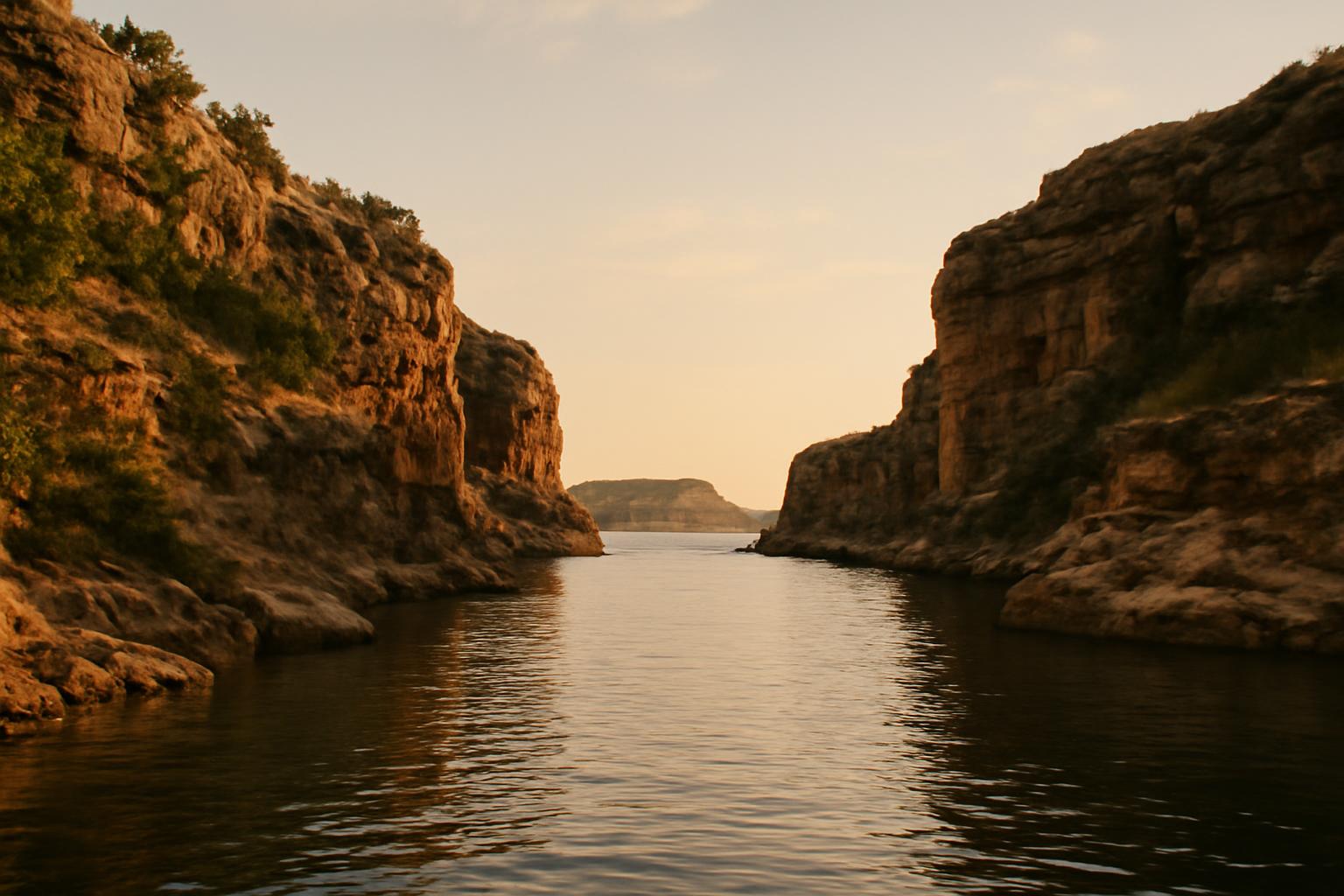
Hell’s Gate is a narrow water passage on the south end of Possum Kingdom Lake, between Devil’s Island and the mainland cliffs. For a first visit, plan around water access, treat land access as unconfirmed, and understand that the cliffs are not an ordinary recreational jumping site.
Place names can be confusing because “Hell’s Gate” is sometimes used for both the passage and the protected water beyond it. PossumKingdomTexas.com describes Hell’s Gate as the strait between Devil’s Island and the mainland, while an Expedia property description characterizes the cliffs as gates at the entrance to a cove. In practical terms, the gate is the opening; Devil’s Island forms one side; and the adjoining cove or basin is where much of the boating and social activity occurs.
The Possum Kingdom Chamber of Commerce visitor page says visitors see the gate by boat or personal watercraft. Other sources make conflicting claims about a land route, so road proximity should not be treated as proof of public entry. Safety also needs to be settled before departure: Brazos River Authority regulations prohibit jumping into the lake from a height of 20 feet or more, and visitor sources describe the main cliffs as approximately 90 feet high.
How visitors can reach and view Hell’s Gate
A boat or personal watercraft is the most consistently supported way to approach Hell’s Gate. The Possum Kingdom Chamber of Commerce explicitly says visitors may see the gate by boat or personal watercraft, and PossumKingdomTexas.com describes entering the cove by passing through the strait. Together, those accounts support a water-first plan, although they do not supply a verified route from a particular launch.
Whether you can lawfully reach or clearly view Hell’s Gate from land is unresolved in the supplied evidence. PossumKingdomTexas.com says the landmark can be accessed from land by Hell’s Gate Loop. A traveler review on Tripadvisor gives more detailed directions involving a dead end, a security gate, and a trail. In contrast, the Chamber’s visitor page says visitors may see the gate only by boat or personal watercraft.
Those sources do not have equal authority over access rights. A traveler’s directions can describe where someone previously walked, but they do not establish current permission to park, cross land, pass a gate, or use a trail. Likewise, reaching a nearby residential road does not guarantee a public viewpoint or an unobstructed view of the passage.
A foreseeable failure begins when a visitor follows old trail directions because the road appears to end near the landmark. The consequence may be arriving at private or restricted property without lawful parking, entry, or a usable view. The responsible response is to stop rather than proceed past signs, gates, or unclear boundaries, then seek current confirmation from the relevant property authority or local public agency. Without that confirmation, do not advertise or rely on the route as public access.
For planning purposes, treat land viewing as unverified and water access as the supported default. That is a narrower conclusion than saying no lawful land viewpoint exists. The supplied sources simply do not establish one with current authoritative evidence.
What to verify before choosing a water route
The evidence does not identify which launch, marina, rental, charter, or tour offers the simplest route to Hell’s Gate. It also does not establish current prices, parking arrangements, reservation requirements, operating hours, or navigation instructions. These are operational details, so confirm them with the facility that will provide your access rather than relying on a general landmark article.
Before committing to a route, verify:
- The launch or marina’s current operating and ramp status
- Parking access, fees, reservations, and after-hours limitations
- Boat or personal-watercraft rental availability and operator requirements
- The route to the landmark, including marked restrictions and hazards
- Whether landing on or near Devil’s Island is allowed and suitable under current conditions
The Brazos River Authority’s public-use information reports seven public boat ramps and numerous public and private marinas around the lake, but that does not identify the appropriate departure point for Hell’s Gate. Its online lake map distinguishes open and closed ramps, making current map status more useful than an undated route recommendation.
What visitors do at Hell’s Gate
Hell’s Gate is associated with sightseeing, cruising, boating, fishing, swimming, and social gatherings. PossumKingdomTexas.com describes the area as popular for boating, fishing, cruising, and hanging out. Texas Co-op Power reports that boaters congregate behind the stone walls and around Devil’s Island.
For a sightseeing outing, the geographic feature itself is the focus. Approaching by water lets you see how Devil’s Island and the mainland create the narrow opening, then how the water expands beyond it. A social outing may instead center on joining other boats in the protected area, swimming, or spending time near a raft-up. These experiences can overlap, but they call for different expectations about noise, vessel traffic, and how long you remain in the area.
The “party cove” description should be understood as an atmosphere, not a complete statement of applicable rules. The visitor sources support the presence of gatherings and heavy peak-season activity, but they do not settle where a vessel may anchor, when swimming is allowed, or what restrictions apply on a particular day.
If your goal is quiet sightseeing, timing matters. If your goal is a group gathering, increased traffic and limited maneuvering space may matter more. In either case, operate according to current markers and regulations rather than copying the behavior of nearby boats.
Peak-season crowds, July Fourth, and special events
Peak periods can be busy and loud. PossumKingdomTexas.com says Hell’s Gate becomes very busy during peak season and is not a quiet destination at those times. The Possum Kingdom Chamber of Commerce also highlights a fireworks waterfall at Hell’s Gate during the Fourth of July celebration.
That evidence supports expecting heavier activity around major summer dates, especially July Fourth. It does not establish an event schedule, viewing zone, launch plan, or traffic-control procedure for a future visit. Confirm those details close to departure, particularly if fireworks or another hosted event is the reason for your trip.
Professional diving has also been associated with hosted events at the landmark. The Breakers Marina distinguishes professional divers at hosted events from ordinary visitors. Event footage therefore is not evidence that recreational jumping is open to the public.
A quieter experience outside peak periods is a reasonable inference from the reported seasonal crowd pattern, not a guarantee. Weather, private gatherings, special events, and ordinary weekend traffic may still affect conditions. Choose timing based on the experience you want, then verify the actual calendar and lake status.
Cliff jumping and visitor safety
Do not treat the approximately 90-foot Hell’s Gate cliffs as a recreational jumping site. Texas Co-op Power describes the passage as flanked by 90-foot cliffs and warns that novice jumping there is both extremely dangerous and illegal. PossumKingdomTexas.com likewise tells visitors not to dive from the Hell’s Gate cliffs.
The controlling numerical threshold in the supplied official evidence is 20 feet. The Brazos River Authority’s lake regulations prohibit diving or jumping into its lakes from a height of 20 feet or more. The regulations also prohibit jumping from public highway, roadway, or railroad bridges and from certain other structures that are not privately owned.
The 20-foot threshold should not be reversed into a blanket permission rule. A jump below 20 feet is not automatically approved merely because it falls below the stated height prohibition. Other restrictions, property controls, water conditions, submerged hazards, access limitations, or temporary rules may still apply. The supplied official material does not identify an approved public jumping location at Devil’s Island, and it does not certify a lower jump as safe.
The Breakers Marina says some Devil’s Island jumps occur from cliffs described as 10 or 20 feet high. That commercial safety article is evidence that people discuss or attempt lower jumps, not authoritative confirmation that a particular ledge is lawful, open, or safe today. Its reference to a 20-foot cliff also requires care because the official rule prohibits jumps from 20 feet or more, not only from heights above 20 feet.
Professional event participation is a separate category. The Breakers Marina says diving from the Hell’s Gate cliffs is prohibited unless the diver is a professional participating in a hosted event. Whatever event permissions or safety systems may apply to professionals, they do not transfer to ordinary visitors. Barriers, event footage, previous competitions, or the presence of other jumpers should never be interpreted as personal permission.
The evidence also does not establish water depth, underwater clearance, rescue coverage, or a reliable method for measuring a ledge. As a result, this article cannot identify a safe lower alternative. The practical conclusion is firm: do not jump from the main Hell’s Gate cliffs, and do not assume a Devil’s Island jump is permitted simply because someone describes it as lower than the gate.
What the evidence does not establish about other water rules
The official regulations provide several general vessel and water-use provisions, but the supplied material does not give a complete, location-specific operating guide for Hell’s Gate. It does not resolve current rules for anchoring, alcohol, swimming zones, special-event controls, or temporary restrictions within the cove.
The Brazos River Authority regulations say watercraft within 100 feet of the shoreline, a boathouse, dock, on-water facility, occupied watercraft, or an area where people are swimming or diving must operate at slow, no-wake speed. They also allow designated prohibited or speed-restricted zones, which are to be marked. Separately, the rules prohibit swimming or wading within 100 feet of public loading docks, boat ramps, or fishing piers.
Those provisions are useful, but they do not answer every situation a visitor may encounter near a crowded raft-up. Markers, temporary controls, event management, and current official notices can affect what is allowed. Do not infer permission to anchor, swim, drink alcohol, or enter a controlled area from the absence of a restriction in a visitor article. Verify the current BRA rules and follow instructions from lake patrol, posted notices, and on-water markers.
What to verify before visiting
Confirm changeable details shortly before departure. General descriptions can explain the landmark, but they cannot establish whether a ramp is open, whether weather makes the outing sensible, or whether an event has changed access and traffic controls.
Use this pre-trip sequence:
- Confirm how you will access the lake. Check the operating status of the chosen ramp, marina, rental provider, charter, or tour directly.
- Check the BRA online lake map for current open or closed ramp markings, then confirm with the operator if the trip depends on one facility.
- Verify parking, launch access, reservations, prices, identification requirements, and return times with the relevant operator.
- Review current lake levels, weather, wind, visibility, and any closure or safety notice before launching. The evidence pack does not provide a current condition report.
- Read the current BRA lake regulations, including no-wake, swimming, diving, and restricted-zone provisions.
- Check for fireworks, hosted diving, or another special event that may change traffic, viewing areas, or on-water controls.
- If considering any land viewpoint, obtain current confirmation of public access and parking. Do not rely on old trail directions or enter past a gate or unclear property boundary.
These checks are part of choosing the outing, not administrative details to handle after arrival. If lawful access, current conditions, or operating restrictions cannot be confirmed, revise the route or leave Hell’s Gate out of that trip.
Frequently asked question
How did Hell’s Gate get its name?
One reported local legend connects the name to a confrontation involving fur traders and Comanches. According to PossumKingdomTexas.com, one trader declared that he would rather pass through the gates of Hell than surrender the furs, after which the point on the Brazos River became known as Hell’s Gate.
That account should be treated as local legend, not established history. The supplied evidence gives only this single visitor-oriented version and does not provide a contemporaneous record or independent historical confirmation. It can explain the story associated with the name, but it cannot establish exactly when, how, or by whom the name was first adopted.