
Zoysia Grass vs. Bermuda: A Conditional Lawn Comparison
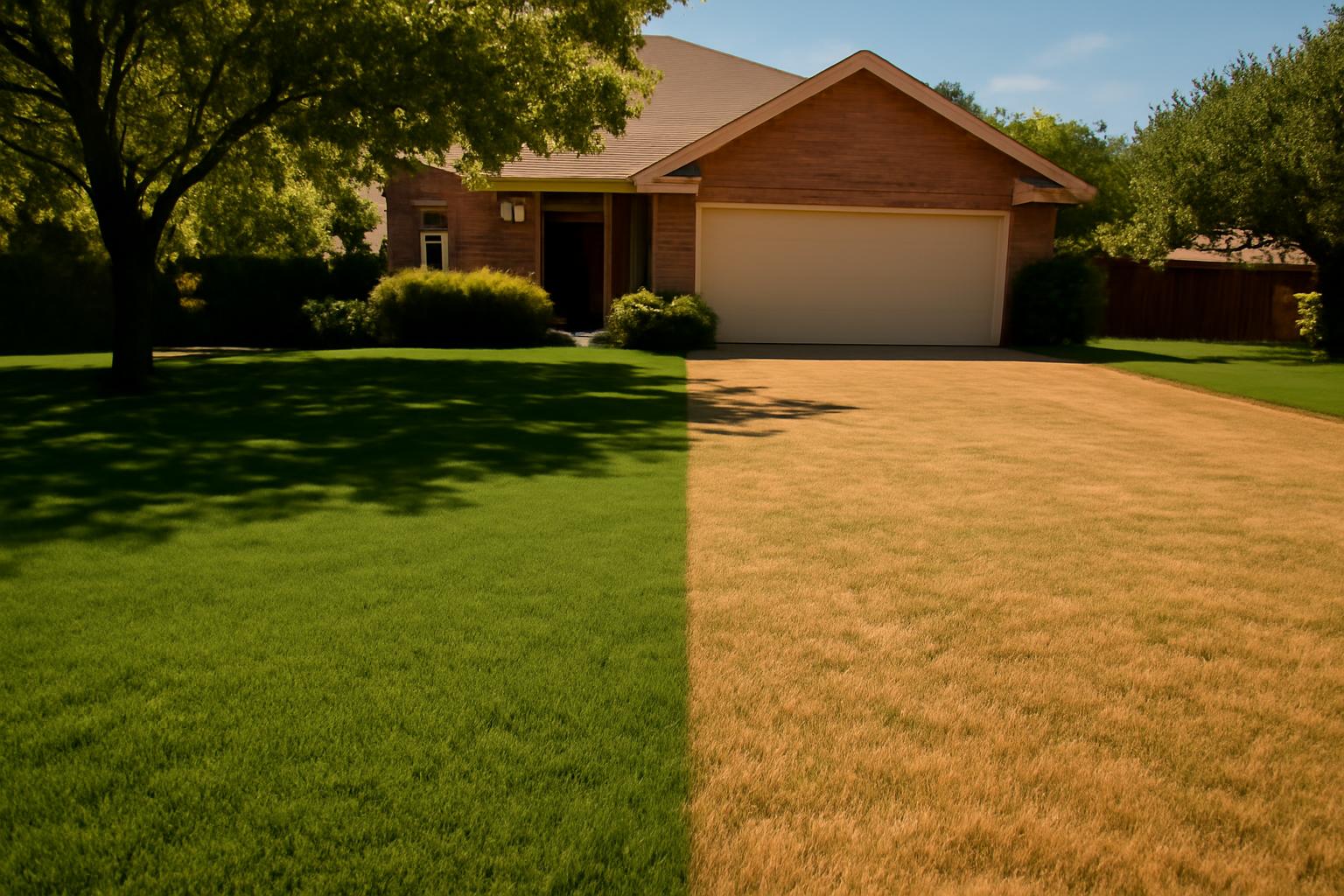
Overview
Choose zoysia for a partly shaded residential lawn where slower growth and less frequent mowing are priorities. Choose Bermuda for a sunny, heavily used lawn where rapid repair matters more than frequent mowing and containment. Cultivar, winter conditions, installation method, and local pricing can change that recommendation.
| Your condition or priority | Usually favors | Why |
|---|---|---|
| Partial shade | Zoysia | Zoysia generally tolerates more shade, although performance varies by cultivar. |
| Full sun | Bermuda or zoysia | Both can perform in sun, but Bermuda is particularly suited to open, sunny sites. |
| Children, dogs, or concentrated traffic | Bermuda | Bermuda generally has stronger wear tolerance and faster injury recovery. |
| Fewer mowing sessions | Zoysia | Its slower growth usually reduces mowing frequency. |
| Fast repair of bare or worn areas | Bermuda | Aggressive lateral growth helps it recover and fill damaged turf. |
| Less edging and containment | Zoysia | Bermuda’s rapid spread can carry it into beds and neighboring turf. |
| Lower upfront installation cost | Often Bermuda | Bermuda seed is more widely available, and Bermuda sod is commonly priced below zoysia sod. Local quotes may differ. |
| Drought performance or low water use | Conditional | Both are drought-adapted, but the available comparisons use inconsistent definitions and do not establish one universal water-use winner. |
| Cold or transition-zone conditions | Cultivar-dependent | Both are warm-season grasses. Locally tested cultivar performance matters more than a broad species label. |
This is a conditional comparison, not an overall ranking. Bethel Farms frames the choice around lawn conditions and maintenance preferences, while Sod Solutions identifies zoysia with shade-tolerant residential settings and Bermuda with sunny, high-traffic areas.
Before buying, identify the yard’s limiting condition. A lawn that is sunny but rarely used presents a different decision from one that receives afternoon shade, daily dog traffic, or regular play. If no single limitation dominates, compare the recurring work and establishment options rather than choosing by appearance alone.
Match the Grass to Your Site
Start with the conditions the grass cannot avoid: its actual light exposure, winter weather, soil information, drainage concerns, and intended use. Then compare locally available cultivars rather than treating all zoysias or all Bermudas as identical.
This distinction matters because cultivar differences can affect shade performance, cold tolerance, blade texture, and disease concerns. Regional examples can be informative, but they do not create universal rules. A cultivar promoted for South Florida, North Texas, or Tennessee should not automatically be assumed suitable elsewhere.
Sun and Shade
Meaningful shade usually moves the decision toward zoysia. Grassperson reports that both grasses can grow in sunny conditions but describes Bermuda as having lower shade tolerance and needing full sun to thrive, while zoysia can tolerate some shade. Sod Solutions reaches the same directional conclusion and notes that finer-bladed zoysia cultivars can differ from the group average.
Published sunlight figures should be treated as estimates, not universal cutoffs. One comparison from Lawn Farm says zoysia needs about four hours of sunlight at minimum. Another comparison gives ranges of four to six hours for zoysia and six to eight hours for Bermuda. These figures come from different sources without a shared cultivar, climate, shade pattern, or performance standard.
Instead of counting daylight hours alone, observe where direct light actually reaches the soil during the growing season. Tree canopy, a building shadow, and filtered light do not create identical conditions. If the proposed lawn has substantial shade, ask for performance information on the exact cultivar under similar local exposure. Even a relatively shade-tolerant zoysia is not evidence that turf will remain dense in every shaded site.
For an open lawn with reliable direct sun, either grass may remain in contention. In that setting, traffic, recovery speed, mowing tolerance, installation cost, and winter performance become the stronger decision factors.
Climate, Dormancy, and Cultivar Choice
Both zoysia and Bermuda are warm-season grasses, and both can enter winter dormancy and lose green color. The comparison should therefore focus on how a specific cultivar performs through local winters, not on whether either species can remain universally green.
Cold performance varies within each grass group. A Tennessee-focused comparison from Tri-Turf Sod Farms cites Latitude 36 Bermuda and Meyer Zoysia as varieties used where occasional hard freezes occur. Sod Solutions likewise identifies cold-adapted cultivars in both groups. These examples demonstrate cultivar variation, but they do not establish a reliable hardiness boundary for every site.
Some commercial comparisons describe Bermuda as more exposed to winterkill or present zoysia as the safer transition-zone choice. That may be useful as a screening signal, but the supplied evidence does not independently validate exact zone boundaries, temperature thresholds, or winterkill probabilities. Exposure, cultivar, establishment quality, and local weather can all be relevant to the purchase decision, so a broad zone number should not be the only filter.
Ask a local turf supplier or extension resource which named cultivars have been evaluated under winters like yours. Verify whether their definition of success means survival, acceptable spring recovery, limited thinning, or full-season appearance. Those are different outcomes. A locally appropriate cultivar from either group is a more defensible choice than an unsuitable cultivar selected because its species has a favorable general reputation.
Soil, Drainage, and Local Validation
Use site information to narrow the cultivar shortlist before requesting a final quote. Because the supplied comparisons do not establish reliable soil-test, drainage, or salinity exclusion thresholds, take actual results to a qualified local source instead of applying a universal online cutoff.
Record the following information:
- A current soil-test report, including every measurement and amendment recommendation it provides
- Areas that stay wet, drain slowly, erode, or dry substantially faster than the rest of the yard
- Any known salinity concern or coastal exposure
- Direct-sun and shade patterns during the active growing season
- The locations of beds, paving, trees, slopes, irrigation zones, and concentrated traffic
- The exact cultivars and installation methods available locally
Ask the supplier or local extension contact to compare each candidate cultivar against those conditions. Also confirm what site preparation is included in an installation quote and what must be completed first. This turns a vague species comparison into a site-specific purchase decision without inventing thresholds the available evidence does not support.
Traffic, Damage Recovery, and Spread
For a lawn exposed to repeated play, running dogs, or concentrated foot traffic, Bermuda usually has the stronger case. The important distinction is that “handles traffic” can describe two separate abilities: resisting the initial injury and repairing the surface after injury occurs.
Sod Solutions reports that Bermuda grasses typically rank above zoysia in wear tolerance and injury recovery. Bethel Farms similarly identifies Bermuda with heavily used lawns because it tolerates foot traffic and recovers quickly. That repair advantage is especially important when activity repeatedly affects the same route, goal area, gate, or dog run.
Zoysia can still form durable, dense turf, so slower recovery should not be confused with automatic fragility. The practical problem is that visible damage may persist longer once it occurs. A lightly used family lawn may never exploit Bermuda’s full recovery advantage, while a yard with daily concentrated use may expose zoysia’s slower repair.
Bermuda’s growth habit creates both its advantage and its main management cost. Lawn Farm describes Bermuda as the faster-spreading grass, and Bethel Farms warns that this aggressive growth can overtake zoysia. The same lateral spread that closes damaged areas can also carry Bermuda into beds, borders, or adjacent turf.
Do not rely on a precise repair promise unless it matches your cultivar, season, and damage type. One source gives a one-to-two-week estimate for dog-related damage, while another says Bermuda may self-repair within days during the growing season. Those claims do not share a controlled definition of damage or recovery. The evidence supports a directional conclusion, faster Bermuda recovery, but not a universal calendar guarantee.
Choose Bermuda when rapid repair is worth additional mowing and containment. Choose zoysia when traffic is moderate, slower repair is acceptable, and reducing routine growth-related work matters more.
Cost, Establishment, and Ongoing Work
Compare total ownership as a bundle rather than asking which grass is simply cheaper. The bundle includes material, delivery, site preparation, installation, establishment care, mowing, fertilizer, edging, and occasional corrective work. The evidence supports lower upfront pricing for Bermuda in many comparisons, but it does not support one universal long-term cost.
Mowing, Fertilizer, Edging, and Thatch
Zoysia is often called lower maintenance, but that label is incomplete. It usually refers to slower growth and fewer mowing or containment demands, not the absence of lawn care.
The most useful comparison is task by task:
- Mowing: Lawn Farm identifies Bermuda as the fastest-growing option in its comparison and says it requires the most frequent mowing. Zoysia Farm Nurseries also says Bermuda needs more frequent mowing because it grows faster.
- Fertilizer: Bethel Farms says Bermuda requires regular fertilization, while Zoysia Farm Nurseries describes its fertilizer demand as higher than zoysia’s.
- Edging and containment: Bermuda’s aggressive lateral growth supports repair but increases the need to keep it out of beds and neighboring turf. A slower-spreading zoysia lawn generally creates less of this particular workload.
- Thatch: Zoysia’s slower top growth does not make it maintenance-free. The comparison evidence flags thatch as a potential zoysia concern, so lower mowing frequency should not be interpreted as lower effort in every year or every lawn.
The workload also depends on the finish you expect. A carefully maintained, closely cut surface creates a different mowing burden from a standard residential lawn. Cultivar and mowing height can affect how frequently either grass needs attention, so obtain a maintenance recommendation for the exact cultivar rather than adopting a species-wide schedule.
The decision is therefore not “high maintenance versus no maintenance.” Bermuda generally asks for more frequent growth control and feeding. Zoysia can reduce mowing and edging frequency, but it still requires monitoring and may need thatch management. Choose based on which tasks you are willing to perform, not on a single maintenance label.
Installation Method, Establishment, and Upfront Cost
Bermuda usually offers more routes from bare soil to turf. Seed is widely available for some Bermuda types, while Bermuda can also be installed as sod, sprigs, or plugs. Zoysia is more commonly associated with sod or vegetative establishment, although the available method depends on cultivar. Do not assume that every named cultivar is available in every form.
This flexibility helps explain Bermuda’s frequent upfront-cost advantage. Grassperson reports that zoysia sod tends to cost more in its North Texas market. A separate Bermuda-versus-zoysia comparison also identifies Bermuda as the cheaper path from bare ground because seed is broadly available and its sod is less expensive in that comparison. Neither source establishes a universal price for all regions, cultivars, or projects.
Bermuda’s faster spread also generally favors quicker surface coverage and repair. Zoysia establishes more slowly, particularly when planted in spaced plugs or sprigs rather than as complete sod. However, establishment claims often mix different endpoints. Sod can create an immediate lawn-like surface without being fully rooted, while plugs can root individually long before they produce complete density.
Define the milestone you care about before comparing timelines:
- Initial rooting
- Readiness for the first mowing
- Enough coverage to limit exposed soil
- Tolerance of ordinary use
- Full, uniform density
The supplied sources do not provide controlled, method-specific timelines using those same milestones. One commercial comparison says Bermuda can form a full lawn in one growing season and zoysia may need two to three growing seasons for full density, but that claim does not control for cultivar, installation method, climate, or what qualifies as “full.” Treat it as directional evidence of Bermuda’s faster establishment, not a schedule for your yard.
Request local quotes for the same scope: named cultivar, material quantity, preparation, installation, delivery, and establishment support. Then ask what milestone each quoted timeline describes. A cheaper material price can be misleading if the quotes cover different installation methods or preparation work.
Drought Performance and Watering
Both grasses are described as drought-adapted once established, but the available evidence does not establish that one always needs less irrigation. The conflict comes partly from using “drought tolerance” as though it measured one outcome.
At least five separate questions may be hiding inside that phrase. How much water does established turf use? How long can it survive without irrigation? How long does it retain green color? How readily does it enter dormancy? How quickly does it recover afterward? A grass can perform well on one measure and less well on another.
For example, Bethel Farms describes both grasses as drought-tolerant but gives Bermuda an advantage in maintaining performance during dry periods. Lawn Farm also describes both as well adapted to drought once established. In contrast, another comparison characterizes zoysia as resisting dormancy longer while Bermuda recovers from dormancy faster. These statements measure different outcomes and cannot be combined into one clean winner.
Even published irrigation figures require caution. Sod Solutions presents about one inch of weekly water for both grasses in its comparison, while another source gives different peak-use ranges for each. The evidence does not show that these estimates were produced under the same soil, weather, cultivar maturity, mowing height, or appearance target.
The safer conclusion is narrow: both grasses can cope with dry conditions, but neither species label guarantees lower water use in your yard. Water demand and visible performance should be evaluated separately. A lawn managed to stay green may receive different irrigation from one allowed to enter dormancy and recover later.
Before choosing, decide what success during a dry period means to you. If survival is enough, your decision may differ from a homeowner who expects continuous green color or rapid recovery after restrictions end. Ask for local irrigation and dormancy guidance tied to the exact cultivar, soil, and desired appearance. Avoid buying on an isolated drought score that does not define what was measured.
Appearance, Texture, and Identification
Blade width is the most concrete repeated visual distinction in the supplied comparisons. ABC Home & Commercial Services gives zoysia a broad blade-width range of 2 to 7 millimeters and Bermuda a narrower range of 1.5 to 2 millimeters. Sod Solutions similarly reports Bermuda blades around 1.5 to 1.7 millimeters.
That makes a fine, narrow blade a useful Bermuda clue, while a visibly broader blade may point toward zoysia. It is not a complete identification test. Zoysia includes fine- and coarse-bladed cultivars, and appearance changes with mowing height, growth stage, and condition.
When inspecting an unknown lawn, use several clues together:
- Compare mature blade width across multiple healthy patches, not one damaged leaf.
- Look at the blade’s growth angle. One commercial guide describes zoysia leaves as growing more vertically and Bermuda leaves as extending outward at a lower angle.
- Examine new growth if you know how to assess vernation, the way a young leaf is arranged in the shoot. That same guide describes zoysia as rolled and Bermuda as folded.
- Compare how aggressively runners cross borders or enter neighboring areas, while recognizing that maintenance can conceal this behavior.
Leaf angle and vernation are supporting clues from a limited source base, so they should not outweigh cultivar identification or a local turf assessment. The evidence supplied here does not adequately support seed-head shape as a dependable comparison, so it should not be used as the deciding feature.
Texture is even less reliable as a species-wide verdict. Zoysia is frequently described as dense, soft, or carpet-like, but the zoysia category covers a wide range of blade widths. Bermuda is often described as finer, and the Floridist comparison identifies soft examples among both fine zoysias and Bermuda cultivars. Mowing context also changes the surface you see and feel.
If appearance matters strongly, inspect mature installations of the exact locally available cultivar at a maintenance height similar to your intended lawn. A generic sample labeled only “zoysia” or “Bermuda” cannot show the full variation within either group.
Using Zoysia and Bermuda in the Same Yard
Both grasses can occupy one property, but unmanaged intermixing is likely to produce an uneven result. The safer strategy is to assign them to deliberately separated zones, such as zoysia in a partly shaded residential area and Bermuda in an open, heavily used area.
The problem is their different growth behavior. Tri-Turf Sod Farms discourages mixing because the grasses grow at different rates and have different textures, creating a patchy appearance. Bethel Farms adds that aggressive Bermuda can overtake slower-growing zoysia.
A split lawn therefore needs a meaningful physical division. USA Sod recommends a mulch bed or hardscape border to limit Bermuda invasion into zoysia zones. A merely imaginary line or a change in mowing direction does not address the underlying spread.
Use the separated-zone approach only when the yard has genuinely different conditions that justify two grasses and when the layout provides a maintainable barrier. Paths, broad planting beds, or other hardscape can make each turf zone visually intentional while giving you room to monitor runners.
If the proposed zones touch directly across a long boundary, selecting one locally suitable cultivar for the whole turf area may be simpler. Where neither grass fits every part of the property, reconsider whether turf is necessary in the most limiting area rather than forcing the two grasses to compete. The practical goal is a stable layout matched to light and use, not an intermingled lawn that requires continuous correction.