
Keep Your Round Moving Fast When Carts Are Stuck on the Path
This is a golf pace-of-play guide. If you mean a vape cartridge, this page is not that resource.
By Reid Callahan · · 19 min read
This is a golf pace-of-play guide. If you mean a vape cartridge, this page is not that resource.
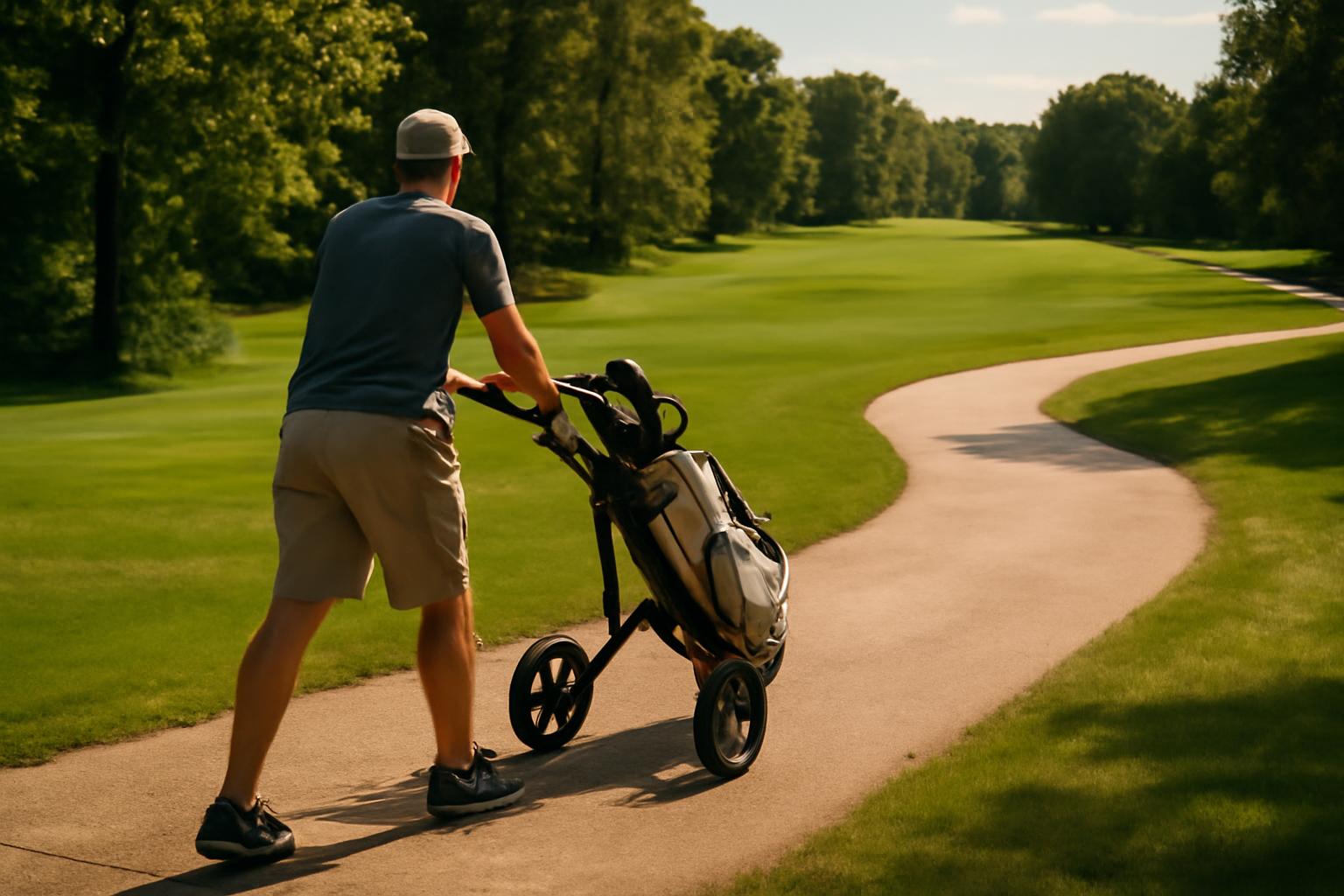
If by “cart” you mean a golf cart, the real problem on wet public-course days usually is not a broken vehicle. It is the backup that starts when a course goes cart-path-only after heavy rain or posts other condition alerts that signal a more fragile setup, such as dew delays or aeration.
That single restriction changes the tempo of the round. Instead of driving directly to the ball, players stop on the path, estimate distance, pull extra clubs, walk in, hit, return, and repeat. On one hole, that feels manageable. Across 18 holes, it creates dozens of extra transitions, and public-course pace is usually lost in transitions more than swings.
Tee Directory uses 4:15 for 18 holes as a strong pace target for a foursome with carts, with a walking foursome around 4:30. In normal conditions, carts can help a round move closer to 3:45. On a cart-path-only day, that advantage shrinks fast. Tee Directory’s booking guidance also notes that cart-path-only after heavy rain can add about 45 minutes to a foursome’s round. That does not make a slow round inevitable, but it does mean your group needs a plan.
A simple one works best:
- Before you leave home: check recent weather, cart policy, and any notes about aeration or overseeding.
- Before the tee time: arrive 20 minutes early, preload GPS or a yardage app, and get everyone ready to play without delay.
- During the round: use ready golf, keep the time between shots tight, and avoid leaving the cart in the way.
- At the green: clear out promptly and do the talking and scoring at the next tee.
The rest of this guide breaks those habits down hole by hole.
Why Cart-Path-Only Rules Slow Down Public Courses
Courses do not use cart-path-only rules as a punishment. After heavy rain, the restriction exists to protect fairways and other turf from repeated cart traffic. On public courses, especially municipal layouts that absorb a lot of play, that matters. Soft ground gets damaged quickly.
Golfers also see the restriction in the same cluster of condition-related alerts that already affect public-course planning. Tee Directory highlights dew delays, aeration schedules, and cart-path-only windows as the kinds of conditions worth checking before you drive to the course. In practice, that means a round can already be starting from a less-than-normal setup before the first tee shot is struck.
The slowdown is not just “more walking.” It is the new sequence each shot creates:
- Stay on the path.
- Find the nearest legal stopping point.
- Figure out whose ball is where.
- Grab one or more clubs and any distance aid you need.
- Walk to the ball.
- Hit.
- Rejoin the cart or continue on foot.
- Do it again for the next player.
That extra sequence is why the 45-minute estimate is useful. It is not a guarantee for every course or every group. It is a realistic planning number for what happens when the restriction gets layered onto a public tee sheet that may already be sensitive to traffic, ability gaps, and slow transitions.
The delay also compounds in predictable places:
- second shots on par 4s
- layups and third shots on par 5s
- the walk from the fairway to the green
- the exit from the green toward the next tee
- narrow path sections where one badly placed cart blocks the flow
Tee Directory’s pace guidance makes an important point here: the biggest killer is the time between shots. Cart-path-only days inflate that problem because golfers now have more opportunities to wait, hesitate, and re-organize. The walking is fixed. The indecision is optional.
That is why some groups handle the restriction reasonably well while others spiral into a five-hour day. The difference is not urgency for its own sake. It is whether the group treats the restriction as a system to manage.
A useful mindset is this: on a restricted day, every player should already be thinking about the next movement, not just the next swing. If your group keeps stopping in neutral positions, discussing obvious choices too long, or leaving the cart where nobody can use it efficiently, the backup begins to spread behind you.
So yes, cart-path-only slows a public course because it adds steps. But it slows it even more when those steps are poorly organized.
Set the Pace from the First Tee on Restricted Days
Most public-course backups are easier to prevent than to fix. Once you are two holes behind the field’s natural pace, you usually spend the rest of the day chasing it. That makes the opening stretch important.
Tee Directory’s advice for a smoother round starts before anyone tees off: arrive 20 minutes early. On a restricted day, those 20 minutes are not dead time. They are setup time.
Use them to handle the details that otherwise leak into the round:
- confirm the cart policy
- check for any notes about wet areas, aeration, or overseeding
- preload your GPS app or yardage screen
- put glove, tees, balls, towel, and rain gear where you can reach them fast
- make sure everyone understands the pace goal for the day
That last point matters. Tee Directory’s benchmark of 4:15 for 18 holes with carts is best treated as a target, not a promise. Layout, traffic, weather, and ability still govern the day. But a group that starts with a shared target tends to make cleaner decisions than a group that never talks about pace until the round is already backing up.
From the first tee, use ready golf. On public courses, that usually means the right player to hit is the player who is ready and safe to play, not the player protected by formal honors. Cart-path-only makes this even more important because the restriction already inserts extra downtime.
Ready golf on a restricted day looks like this:
- if the fairway is clear and you are prepared, hit
- do not wait for ceremonial order when it adds nothing
- do not let the whole group watch one player go through every thought out loud
- be getting ready while others are hitting, not after
The first two holes are also the time to establish how your group will move between balls. You do not need a complicated system. You do need a shared expectation that the cart should never become a parked meeting room where everyone waits for everyone else to decide.
A practical way to think about it is simple: when the cart stops, each player should know quickly whether they are walking in with clubs now or staying with the cart to the next legal point. That decision should happen in seconds, not after a group conference.
A clean opening-hole routine often has a few common traits:
- the cart is parked legally and out of the main flow
- the next player is already taking clubs before the cart fully settles
- the partner is either preparing for the next stop or getting useful information ready
- nobody finishes a shot and then stands still waiting for the next instruction
This is where the public-course pace target becomes practical instead of theoretical. A 4:15 round is not produced by one dramatic burst of speed. It is produced by dozens of small moments where the group avoids dead air.
That is especially true under restrictions. On a normal cart day, sloppy organization can sometimes be hidden by the cart’s convenience. On a cart-path-only day, it is exposed immediately.
If you want the round to stay near its benchmark, set that standard on the first tee: arrive ready, use ready golf, and make the cart part of the flow rather than the center of the delay.
Optimal Cart Positioning to Minimize Walking
Good cart positioning on a restricted day is not about clever tricks. It is about removing unnecessary extra trips.
The core principle is forward planning. Every time the cart stops, ask one question: Where does it need to be next so the group keeps moving? If nobody asks that, the cart tends to get left in convenient-but-neutral spots that force everyone to double back.
A few positioning habits help immediately:
- stay legal and stay on the path
- avoid stopping where another cart cannot pass cleanly
- avoid parking across turns, crossings, or green exits
- leave the cart pointed toward the group’s next movement whenever possible
That last point matters more than golfers think. Much of the wasted time on restricted days comes after the shot, when players realize the cart is still behind the action and now has to be retrieved or repositioned before anyone can advance.
This is where a little planning between partners helps. If two riders’ balls are separated, the faster choice is often for one player to take the needed clubs and walk in, while the cart remains positioned for the next useful move. That is not a rigid rule for every hole. It is a way to keep the cart from serving as a shuttle for every single step.
The goal is not to eliminate walking. That is impossible under cart-path-only. The goal is to eliminate wasted walking:
- walking back to a poorly parked cart
- walking across traffic because the cart was left on the wrong side of the hole
- waiting for a partner to drive backward through the sequence
- clustering both players at one access point when the balls do not require it
Near greens, the same logic applies. The most useful parking spot is usually the one that supports the exit, not the one that simply feels closest at first glance. If the cart is left where the group must walk backward after holing out, the delay does not just hurt your group. It occupies the same path space the following group needs.
That is where cart size becomes a practical point. Tee Directory’s golf-cart length guide notes that common stock two-passenger 2005-era carts run roughly 91.5 to 93.9 inches long. A Club Car DS or Precedent is documented at 91.5 inches, while a Yamaha G22A/G22E is 93.9 inches. That does not mean your rental fleet is one of those exact carts, and modifications can change overall space. It does mean a standard cart takes up more path real estate than many golfers intuitively allow for.
That is why small parking mistakes create bigger bottlenecks than expected:
- a rear wheel left hanging into the main path narrows the lane
- two carts parked side by side near a crossing can choke the turn
- a cart left diagonally near a bridge approach can block the next group even when nobody is actively using it
If you treat the cart as a moving base rather than a static seat, positioning improves quickly. A well-placed cart on a restricted day should be:
- legal
- out of the main lane
- easy to rejoin
- close to the group’s next movement, not just its previous one
That is the practical version of “minimize walking.” You cannot remove the walk in to the ball. You can remove the extra wandering created by poor staging.
Pre-Shot Habits That Unclog Cart Path Flow
Once the cart is positioned sensibly, pace comes down to what happens between arrival and contact. Tee Directory’s pace guidance is blunt about this: the biggest pace killer is the time between shots.
That is good news, because it means much of the slowdown is still under player control.
The first fix is to make your preparation happen while moving, not after you arrive at the ball. By the time you walk off the path, you should already be narrowing the choice:
- likely club
- backup club
- target
- approximate yardage
You do not need to be reckless. You do need to avoid treating the walk as dead time and the ball as the place where all thinking begins.
The same principle applies to practice swings. Most public-course players do not gain much by turning every shot into a long rehearsal. On a restricted day, excessive rehearsal is even more expensive because the walk in has already lengthened the process. Keep the routine compact. If you take a practice swing, make it purposeful.
A good self-check is simple: when it is safe and your number is known, your pre-shot routine should feel brief and repeatable, not theatrical. Pace falls apart when one player’s internal routine becomes a group delay.
That same “do it on the move” mindset helps with maintenance and etiquette tasks:
- replace a divot right after the shot
- rake the bunker as you leave it
- repair a ball mark when you reach it on the green
- mark and tend efficiently instead of in separate, drawn-out stages
These habits do not compete with pace. They are part of pace when done smoothly.
Phones are another quiet cause of delay. Tee Directory’s etiquette guidance treats phone use as a practical pace issue, not a ceremonial one. The rule of thumb on a restricted day is straightforward: keep the phone on quiet vibrate and use it only when you need it for something relevant, such as GPS or weather. The real problem is usually not one dramatic interruption. It is repeated distraction—looking down, missing your turn, then starting late.
Putting is similar. You do not need to rush on the green, but you do need to use shared time well. Read your putt while another player is preparing. Be ready to mark, tend, or finish out without turning the green into a series of unrelated mini-events.
The difference between a group that moves and a group that stalls is often visible in one simple pattern:
A quicker group is almost always doing one of three things:
- preparing
- hitting
- moving on
A slower group adds a fourth habit:
- standing around waiting for the next obvious step
On cart-path-only days, that extra standing is what makes the round feel clogged.
So if you want a single question to carry all day, use this one: What can I do right now so the next shot happens sooner? Often the answer is not dramatic. It is just cleaner preparation—choose the club sooner, walk in with a plan, keep the phone away, and make the routine shorter than the walk that got you there.
Etiquette Rules for Smoother Cart Path Play
Public-course etiquette matters most when it directly affects pace. On a restricted day, the round usually slows not because one group commits a spectacular violation, but because several small delays pile on top of each other.
The first big one is obvious: if your group is holding up a faster group and there is room ahead, wave them through when the hole allows it. Tee Directory’s pace framework is practical, not precious. Public golf works better when groups match the speed of the space in front of them, and ego is rarely a useful pace strategy.
The next major habit is the green exit. Once the hole is finished, clear the green promptly. Do not turn the cup area into the place where scoring, stories, club sorting, and reaction analysis all happen. Those things can be handled at the next tee or while another player is preparing.
That prompt exit matters because the benchmark numbers are already tight. Tee Directory uses about 4:30 as a target for a walking foursome, while carts can help create something like 3:45 to 4:15 in better conditions. Cart-path-only eats into the cart advantage. If your group then lingers around every green, delays the next tee, or refuses to let faster players through, the restriction stops being the only reason the round is slow.
A few etiquette habits have outsized value on these days:
- Park with the next move in mind. A good parking choice helps the whole group leave the hole faster.
- Handle tending and marking efficiently. If a player needs the flag tended or a ball marked, do it cleanly and move on.
- Talk away from bottlenecks. The green complex is the wrong place for scorecard math and post-hole debriefs.
- Stay aware of the group behind. If they are consistently arriving while you are still on the green or teeing off late because of you, that is useful information.
Etiquette also starts before the car is loaded. Tee Directory’s planning guidance points golfers to course-condition checks that include aeration, dew delays, and cart policy. If you know the course is already posting fragile-condition notes, you can arrive expecting a more disciplined round instead of being surprised at the starter shack.
That mental shift helps more than it sounds. Groups that frame the day correctly tend to behave differently. They play ready golf sooner, keep chatter moving, and accept that a restricted round rewards efficiency.
So etiquette on a cart-path-only day is not mostly about old-school form. It is about reducing the number of times your group becomes the reason somebody else stops.
Course Selection and Booking to Dodge Path Restrictions
One of the easiest ways to improve pace on wet weeks is to make better choices before you ever reach the first tee.
Tee Directory’s course-selection guidance starts with a simple screen: choose a public course by slope rating, pace reputation, walk/cart policy, and recent conditions. Those four filters matter on any day. They matter even more when the weather has been soft enough to raise the odds of cart restrictions.
Start with difficulty. Tee Directory explains that slope ratings run from 55 to 155, with 113 as the neutral baseline. That matters for pace, not just handicap math. A harder course punishes misses more severely. Under cart-path-only rules, those extra penalties do not just cost strokes. They cost time: longer searches, more recovery shots, and more back-and-forth movement from path to ball.
That makes a wet weekend a good time to ask what kind of round your group actually wants. If the goal is a smooth public day, a very high-slope course with a slow reputation may be the wrong call, even if it is attractive on paper.
Recent conditions matter just as much. Tee Directory’s planning articles emphasize checking for notes about:
- recent rain
- cart policy
- aeration
- overseeding
- other course-condition alerts
Those notes do not guarantee a cart-path-only day, but they do tell you whether one is more plausible. They also help prevent the most frustrating version of a restricted round: the one your group never saw coming.
Booking timing is the next lever. Tee Directory’s booking guidance says most city-run courses open their booking window exactly seven days in advance, and the release typically goes live at midnight, 6 AM, or 7 AM local time. Some systems use 14-day windows, so the course’s own booking page is the place to verify the exact schedule.
The practical lesson is simple: if you want the best chance at a strong tee time, know the release moment and be ready when it opens. On many municipal systems, that difference decides whether you get prime morning inventory or the leftovers.
Why does that matter for cart-path-only pace? Because tee times are not equal. A course that is manageable early can feel very different once accumulated delays are built into the sheet. If wet conditions are already making the day fragile, starting in a better slot can help reduce the chance that you inherit a backlog from the outset.
A solid restricted-day booking checklist looks like this:
- confirm the exact release time
- check recent weather
- read condition notes
- verify cart policy
- look for aeration or overseeding notices
- consider slope rating and the course’s pace reputation
If you want a deeper breakdown of release schedules, Tee Directory’s tee-time booking windows guide is useful because it separates municipal, resort, and daily-fee patterns instead of treating all public golf the same.
The larger point is strategic: you cannot always avoid cart-path-only rules, but you can avoid pairing them with the worst possible setup. The wrong course, the wrong time slot, and the wrong group match can turn a manageable restriction into an all-day drag.
Twilight and Hot Deals for Faster Cart Path Rounds
Value tee times can be a smart play on restricted days, but only if you understand what you are buying.
Start with twilight. Tee Directory notes that twilight rates usually begin 2 to 3 hours before sunset and often cut fees by 40% to 60%. That is a real discount, which is why these slots remain popular.
Pace-wise, twilight cuts both ways.
The upside is cultural as much as financial. Twilight groups often know they have limited daylight, so they tend to move with clearer intent. That can make the round feel brisker than a relaxed mid-morning sheet.
The downside is sheet management. Tee Directory also notes the common tradeoffs: compressed tee sheets, more pressure to keep groups moving, and a higher chance of being paired with singles. So twilight can feel faster, but the speed is not guaranteed by the clock alone.
Twilight usually makes sense when:
- your group values price
- you are comfortable with a little uncertainty about finishing 18
- you do not mind being paired
- your group already plays with decent pace habits
It is less attractive when:
- you want maximum control over the day
- your group dislikes pairings
- you expect a leisurely full round regardless of light
- the course already has a slow-play reputation
GolfNow hot deals are a different kind of value play. Tee Directory’s booking coverage says they typically appear 24 to 48 hours out and are often 30% to 50% below rack rate. They also tend to show up in the slots a course most wants to clear, often early or late.
That makes them useful in wet weeks for golfers who want flexibility. Instead of locking in days ahead and hoping the weather behaves, you can react closer to the round. The tradeoff is control. Hot deals reflect what the course wants to sell, not necessarily the ideal pace window you would choose yourself.
The same tradeoff applies to the walk-up strategy. Tee Directory notes that public courses often see 5% to 15% no-shows on weekday mornings, with the most reliable walk-up window after 10 AM. For flexible golfers, that can be a practical way to let actual conditions reveal themselves before committing.
Walk-ups work best when:
- your schedule is flexible
- you can play weekdays
- you are comfortable taking what opens up
- you would rather react to real conditions than forecasts
So are value tee times worth it on cart-path-only days? Often, yes—but for different reasons.
- Twilight can lower cost and sometimes improve urgency, but may come with tighter spacing and pairings.
- Hot deals can save meaningful money, but the course controls the timing.
- Walk-ups can exploit no-shows, but only if your calendar has slack.
If your top priority is the smoothest possible pace, booking right when the course’s main window opens is usually still the best play. If your top priority is flexibility or price, late-release options can be smart.
Either way, the lesson is the same as it is on the course: a restricted round gets easier when you make deliberate choices early.
Wet conditions will always test pace. But with the right booking habits, realistic course selection, better cart positioning, and cleaner ready-golf routines, cart-path-only golf becomes a planning problem—not an all-day traffic jam.
How much extra time does cart-path-only add to 18 holes?
A practical public-course estimate is about 45 extra minutes for a foursome on 18 holes after heavy rain. The exact effect still depends on the course, the group, and how well players manage the time between shots.
What is the target pace for a foursome with carts?
A strong benchmark is 4:15 for 18 holes for a foursome with carts. Tee Directory also uses 4:30 as a target for a walking foursome, while carts in normal conditions can sometimes help a group play closer to 3:45.
When do most municipal courses open tee time booking?
Most municipal courses open their booking window exactly seven days in advance. The release usually goes live at midnight, 6 AM, or 7 AM local time, and some systems use 14-day windows, so it is worth checking the course’s own booking page before relying on habit.
What are typical lengths of 2005-era golf carts?
For common stock two-passenger models from that era, a useful planning range is about 91.5 to 93.9 inches long. A 2005 Club Car DS or Precedent is documented at 91.5 inches, while a Yamaha G22A/G22E is documented at 93.9 inches. Actual fleet dimensions can vary with model and modifications.
How to check for cart-path-only before booking?
Check the course’s own booking page and condition notes before you commit. Tee Directory’s planning guidance points golfers to items like recent weather, cart policy, aeration, and overseeding because those alerts help you judge whether restrictions are more likely.