
Standard Golf Score: Why the Answer Is Par
The three-letter answer to “standard golf score” is PAR. Crossword references including Wordplays and Crossword Solver identify PAR as the standard number of…
By Reid Callahan · · 3 min read
Overview
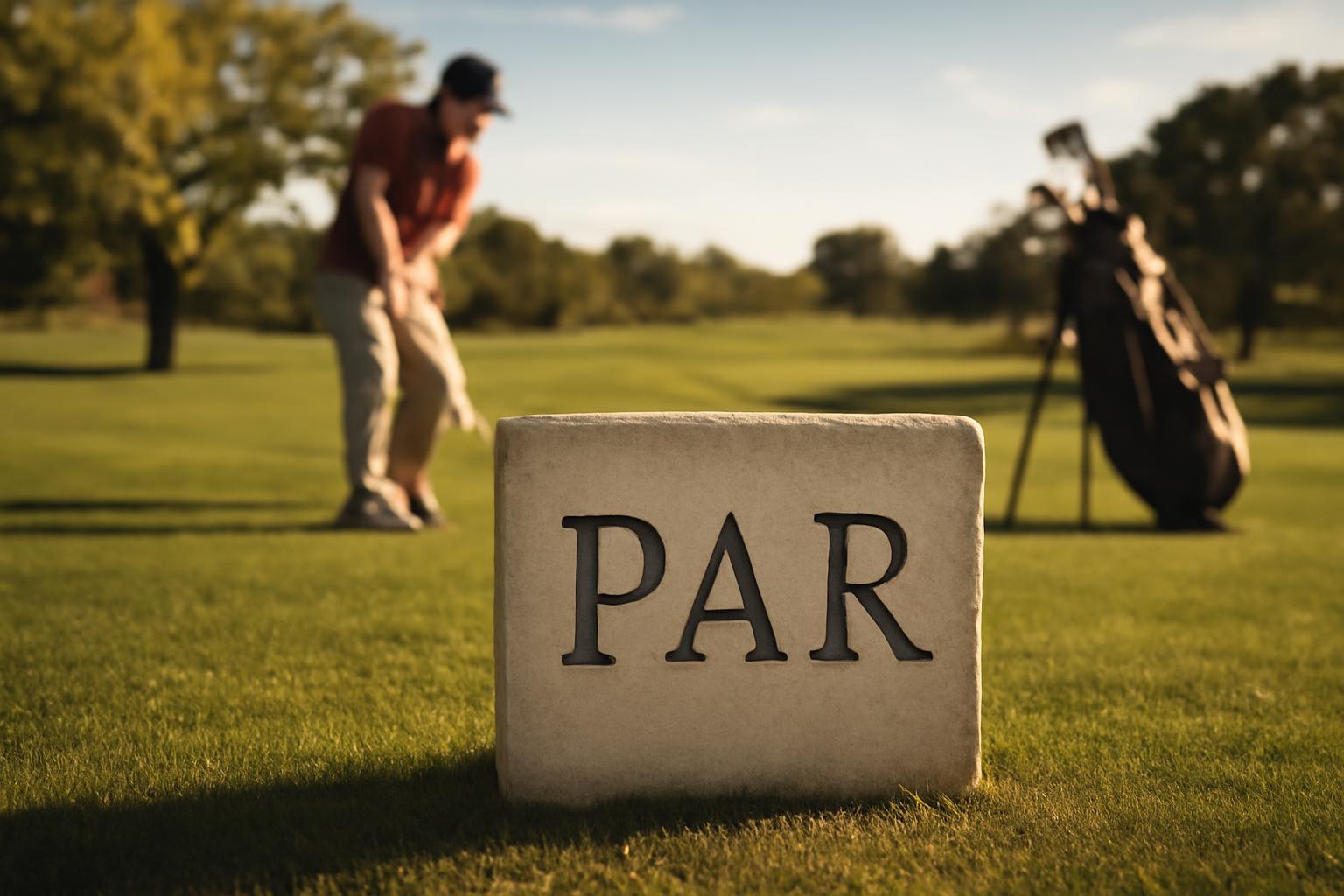
The three-letter answer to “standard golf score” is PAR. Crossword references including Wordplays and Crossword Solver identify PAR as the standard number of strokes assigned to a golf hole or course.
For a puzzle, first confirm that the answer requires three letters. Then compare PAR with the crossing letters. Other golf terms may appear in clues about particular scoring results, but PAR fits this wording because it names golf’s benchmark score rather than one specific above-par or below-par outcome.
What par means in golf
Par is the predetermined number of strokes a proficient golfer is expected to need. According to the overview of par in golf, the benchmark can apply to one hole, an entire round, or a multi-round tournament. A round’s par is the sum of the par values for the holes played, while a tournament’s par combines the round totals.
Each hole receives its own par. Playing length is the primary consideration, although terrain and obstacles may also influence the assigned value, according to the same overview. The Treetops beginner scoring guide explains that individual holes are commonly par 3, par 4, or par 5.
An 18-hole course commonly has a total par of around 72, though 72 is not a universal total. When you see “par 72,” it means the assigned benchmarks for all 18 holes add up to 72 strokes. It does not mean every player is expected to finish in exactly 72 strokes.
This distinction explains why PAR is the crossword answer. It is a fixed point of comparison established for the hole, round, or tournament, not a label for whatever score happens to be common among the players on a particular day.
How golf scores compare with par
Golf scores are described by comparing the strokes taken with the applicable par. The par scoring overview defines a matching score as even or level par, a lower total as under par, and a higher total as over par.
Consider a player who takes 75 strokes on a par-72 course. The calculation is:
75 strokes − 72 par = +3
The player therefore finishes three over par, usually written as +3. The raw score is 75, while +3 expresses that result relative to the course benchmark.
The same comparison produces the familiar names used for individual holes. The Treetops scoring guide defines a birdie as one stroke under par, a bogey as one over, and a double bogey as two over. On a par-4 hole, that gives the following mapping:
- 3 strokes: birdie, or one under par
- 4 strokes: par, or even par
- 5 strokes: bogey, or one over par
- 6 strokes: double bogey, or two over par
These terms describe the relationship between the player’s actual strokes and the hole’s predetermined par. They do not replace the raw stroke count. If you know the par and the number of strokes taken, subtracting par from the stroke total tells you whether the result is even, under, or over par.
Why par is not the average golfer’s score
Par is golf’s standard benchmark, but it is not necessarily the score an average recreational golfer records. The benchmark describes proficient play. An average, by contrast, attempts to summarize the observed results of a particular group of golfers.
That group matters. Piqua Country Club’s discussion of good golf scores notes that what counts as good depends on a golfer’s experience and goals. A score that represents progress for a beginner may not have the same meaning for a more experienced player. Course par remains the comparison point in either case.
Published recreational averages also require qualification. GolfNow observes that many golfers do not keep score or do not consistently apply golf’s rules, making a definitive overall average difficult to establish. Stitch Golf adds that reported figures may reflect only golfers who actively submit scores online. Such samples can exclude many casual rounds and players.
For that reason, no single recreational average should be treated as universal without knowing who was measured and how scores were recorded. In the phrase “standard golf score,” standard points to PAR, the predetermined benchmark. It does not promise a typical result for the average golfer.